
BitBox02 Review – is it a good option for cold storage?

This year has been brutal thus far in the cryptocurrency markets. Among the bearish developments has been a bunch of centralised entities filing for bankruptcy, the most high-profile of whom was Celsius.

Against this backdrop, the mantra of “not your keys, not your coins” rings truer than ever. As contagion ripples across the industry, there is only one way you can be absolutely sure that your Bitcoin (and other cryptocurrencies) is safe. And that is cold storage – something I warned about the day the UST peg began to slip.

A few months down the line, we are not out of the woods yet, despite the initial wave of bankruptcies now in the rear mirror – including Celsius, Voyager Digital, Three Arrows Capital.

Today, I write a review of the BitBox02 hardware wallet. Aiming to make it as simple as possible, this will be an objective review of the wallet outlining its pros and cons.

Details and unboxing

Made by Shift Crypto, which is based in Switzerland, the BitBox02 wallet retails for $128. The version I am trying out allows storage of several assets, including Bitcoin, Litecoin, Ethereum and ERC-20 tokens. However, for you Bitcoin maxis out there getting sweaty palms just reading the word “Ethereum”, there is a Bitcoin-only version also produced. It retails for the same price of $128.

In the box are several additives. Firstly, the wallet comes with a USB-C to USB-A adapter, so no issues if your laptop is too old for the now-ubiquitous USB-C slots. It also comes with an extension wire, allowing you to plug the device into your laptop while holding it in your hand, connected to the laptop via the cable. This is far from necessary, but a nice option.

Finally, there is a clasp that allows you to hook your device onto a keyring, belt or whatever else you want. There is also a microSD card in addition to the hardware wallet itself.

Oh, and don’t forget the Bitcoin stickers!

How to use the BitBox02

First, I downloaded the app from https://shiftcrypto.ch/app/.

Then, I inputted the microSD backup card into the device. The point of the microSD card is to backup your wallet in case of loss or damage. There is also an excellent but simple feature to set a universal 2FA option, a neat bit of security. 

On the app screen, I hit “Install Firmware”. Also, a nice touch – you can hit “flip screen” on and it flips the screen around on the wallet, making it easier to read (I only have a USB-C slot on one side of my laptop). Next, you verify that the code on your BitBox matches the one on your laptop screen.

I hit “Create wallet”. 

I’m required to type in a password. To do this, you use invisible touch sensors on each side of the device. This is a really cool feature, and probably the standout one of the wallet.  You can touch, swipe and hold the sensors to carry out all actions on the device. It adds a nice futuristic feel to the whole thing.

In setting the password, it does take a bit of time to work the sensors as you need to click each button several times. So, there was a fair bit of poking around and it’s quite tedious. Nevertheless, the process is intuitive and gets easier once you are used to the settings. Other than the password – which is manageable – the sensors work really well. 

Using the device

The options on the app are great. I can set a 2FA, manage my backups, see my wallet balances, look at my transactions – all the basics, in other words. It’s minimalistic and easy to navigate, which for a wallet is all I really need – I don’t need my cold storage wallet to have a glistening interface on par with the best-built websites on the Internet. 

Next, I send some Bitcoin to my the device, scanning the QR code easily on the app. Unfortunately for me, it’s the Bitcoin I had left over from my recent trip to El Salvador – I was perhaps too ambitious with my expectations of how many merchants would accept Bitcoin there – but I can’t really blame BitBox for that, can I? So across goes my $360 in Bitcoin into the hardware wallet. 

Once there, I send it back out of the device, just so I can tell my dear readers what it’s like to withdraw, too (the things I do for you!). And well, it’s…easy. There isn’t much to say. You type in the transaction and then via the touch sensors on the device you hold the (invisible) buttons to sign the transaction.

That’s kind of all there is to it.

Pros

  • Nice screen makes it very easy to use
  • Comes with USB-C, USB-A adaptability
  • Comes with a backup memory card
  • Excellent 2FA options
  • App provides all you need to know to get set up easily, even for crypto noobies

Cons

  • Far from a dealbreaker but setting the password is a little tedious on the touch sensors


Verdict

The BitBox02 doesn’t do much, but it does everything it should. It stores your Bitcoin well. It’s simple to set up, even for those with no prior knowledge (I tested this with my friend, who said the start-up guide was excellent).

Signing transactions couldn’t be easier. The backup option in the microSD card (which is totally optional) is great, too. And the 2FA option is something I love.

To wrap things up, at a $128 price point this wallet does exactly what it needs to and I really can’t think of anything to put people off buying it. In the current climate, it’s vital to take ownership of your coins if you intend to hold either for a long period of time or possess a significant quantity. Against the myriad potential downfalls of not storing your coins cold, a $128 investment and 10 minutes of your time to set it up are drops in the ocean.

Sure, if you only hold a small amount or don’t expect to hang on to your crypto long, the safer exchanges are fine. But otherwise, cold storage is just safer, easier and more sensible. The BitBox02 is built for exactly that – and it delivers.

Finally, it’s open-source, which is cool. And shout out to whoever decided to include stickers in the box! 

The post BitBox02 Review – is it a good option for cold storage? appeared first on CoinJournal.

Bitcoin eyes the $22k resistance level as the market slowly recovers

Bitcoin could rally towards the $22k resistance level over the coming hours as the broader market slowly recovers.

The cryptocurrency market is slowly recovering today, following a slow start to the week. After losing more than 3% of its value on Monday, the crypto market is up by nearly 2% in the last 24 hours. 

The positive performance has pushed the total cryptocurrency market cap above the $1 trillion mark again.

Bitcoin nearly dropped below the $21k support level on Monday but has maintained its value above that threshold. Bitcoin is now trading around $21,400 per coin and could make a move for the $22k resistance level over the next few hours if the market momentum is maintained.

Bitcoin reaching the $25k psychological level in the near term would depend on the sentiment in the broader cryptocurrency market. 

Key levels to watch

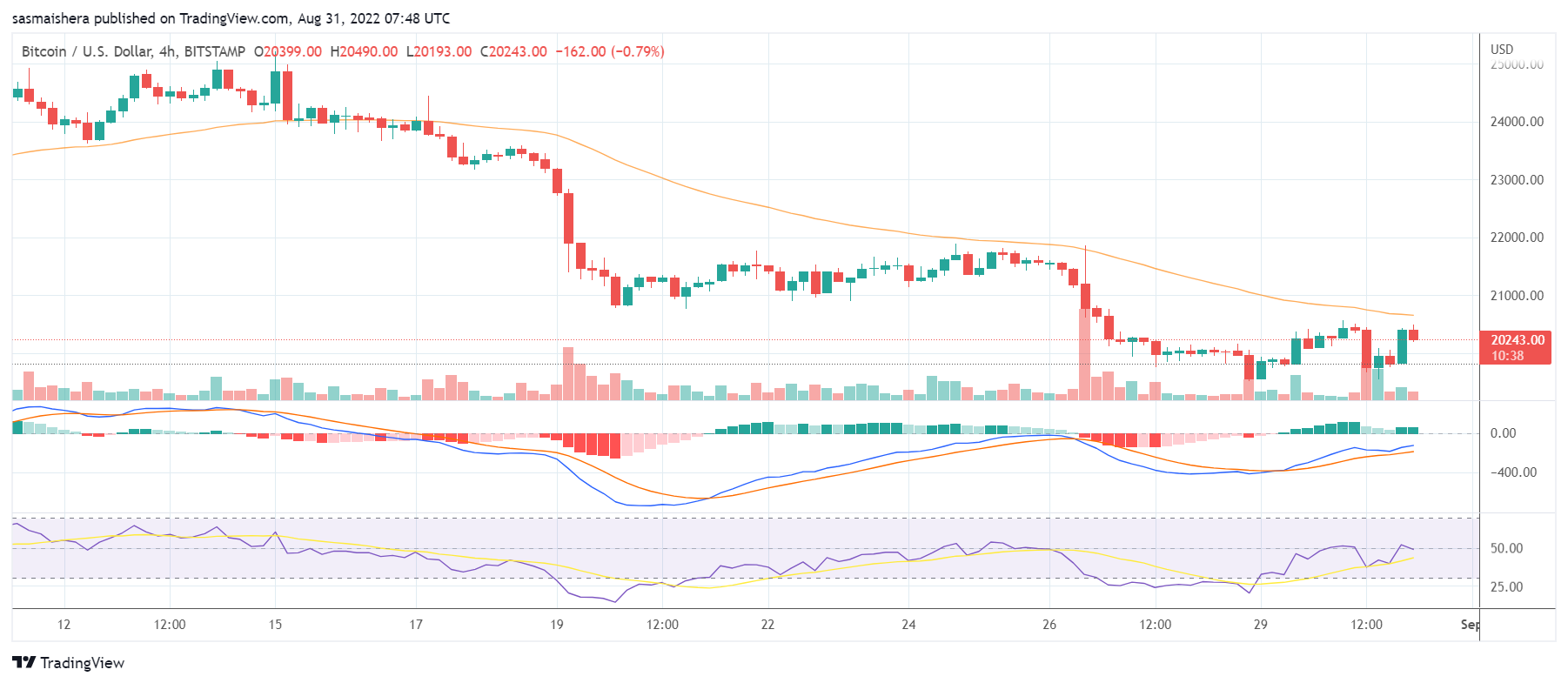
The BTC/USD 4-hour chart remains bearish despite Bitcoin adding 1% to its value in the last 24 hours. The technical indicators show that Bitcoin’s performance is improving, but it is yet to be bullish.

The MACD line dropped into the negative zone on August 16 and has remained there. Thus, indicating that the bearish trend for Bitcoin is not yet over.

The 14-day relative strength index of 44 shows that Bitcoin is no longer in the oversold region. However, it is still some way from entering the overbought zone of the chart.

At press time, BTC is trading at $21,360 per coin. If the market recovery continues, BTC could surpass the $22,724 resistance level over the next few hours or days.

However, Bitcoin could find it hard to reach the second major resistance level at $23,960 in the near term unless there is a bullish movement.

The bears are still lurking and could regain control of the market. Doing so would see BTC fall below the $21k support level for the second time in less than a week. 

Bitcoin has maintained its value above $20k and should comfortably do so over the next few days.

The post Bitcoin eyes the $22k resistance level as the market slowly recovers appeared first on CoinJournal.

Bitcoin isn’t going away, says Bakk’t CEO

Bitcoin is down by more than 60% from its all-time high, but Bakkt’s CEO says the leading cryptocurrency isn’t going away.

Gavin Michael, the CEO of ICE-owned Bakkt, told Yahoo Finance in an interview on Friday that Bitcoin isn’t going away. He made this statement at a time when Bitcoin and the broader cryptocurrency market are underperforming. 

Michael said institutional interest in cryptocurrencies is growing despite the ongoing bear market. He said;

“There’s still strong interest and momentum with our partners, many of whom are multinational companies… They understand the peaks and troughs that we’re seeing. [But] we are anticipating that the partners may move at a slightly more conservative pace. They’re being more thoughtful about how they enter the crypto economy.”

The crypto market has seen its total market cap drop from $2.2 trillion at the start of the year to currently stand around $1 trillion. Despite that, Michael said he expects Bakkt to remain engaged with its crypto services in the second half of the year, and expects a massive ramp-up through 2023. He said;

“We’re seeing this change in narrative, if you like, from crypto being viewed simply as an investable asset to a more widespread utility across consumers, across businesses, and across institutions. So our work is about working with our partners to really unleash [crypto’s] functionality and its full utility.”

The bear market is a time to grow, and Bakkt has been doing just that. The company, which operates a crypto trading platform for institutional investors, announced a new partnership with Visa earlier this month and has an existing partnership with Mastercard. 

The partnership with Visa will see Bakkt offer crypto debit and credit cards, making it easier for consumers to pay using cryptocurrencies. 

Bakkt’s partnership with Mastercard empowers companies to offer crypto as part of their loyalty reward programs. Michael said;

“We’re seeing consumers who value their loyalty points even more in this challenging economic environment. They see it as a way to offset rising costs.”

Bakkt’s revenue increased by 60% in the second half of the year, thanks to the sales growth from consumers redeeming loyalty points for crypto.

The post Bitcoin isn’t going away, says Bakk’t CEO appeared first on CoinJournal.

Bitcoin price: Peter Brandt suggests possible bottom for BTC

  • Bitcoin looks to have reached levels similar to those hit before a bounce in July, veteran trader and analyst Peter Brandt says. 
  • However, with risk-off sentiment largely intact, he notes it might not be time to flip so bullish.
  • BTC/USD was trading near $21,400 at the time of writing.

Bitcoin price is about 1.2% up in the past 24 hours at the time of writing, trading above $21,400 as bulls look to push higher.

The slight gains on the daily chart have two small green candles after six consecutive red ones.

However, with the broader market largely undecided, the bellwether cryptocurrency is still vulnerable to the sell-off that pushed BTC/USD from highs above $25,000 last week.

Chart showing BTCUSD price movement and key levels. Source: TradingView

Ascending wedge targets: what’s next for BTC?

On Friday, BTC price fell nearly 10% as the broader risk assets market sank on news the US Federal Reserve was intent on maintaining a hawkish approach despite data suggesting a slowing inflation.

The risk-off sentiment saw Bitcoin hit its lowest price level in over three weeks ($20.760 on Coinbase, with the pair down nearly 12% this week). Here’s what legendary trader Peter Brandt says about the BTC price movement:

The benchmark cryptocurrency is therefore poised at key downside targets, Brandt said as pointed to a chart indicating a breakdown from an ascending wedge.

It’s possible for some bounce from here if bulls hold support, but more pain is likely if the demand reload zone breaks, a scenario crypto analyst Michael van de Poppe also highlights in the tweet below.

The last major breakdown below $20,000 saw BTC/USD fall to lows around $17,600.

The post Bitcoin price: Peter Brandt suggests possible bottom for BTC appeared first on CoinJournal.

Bitcoin breaks below Realized Price as bears push BTC below $21.4K

  • Bitcoin has declined by more than 8% in the past 24 hours to currently trade below $21,400.
  • Glassnode data shows Bitcoin Realized Price is $21,700.
  • BTC price has fallen below the realized price before – December 2018 and March 2020, with June, July and August 2022 also seeing the scenario.

Bitcoin has declined by more than 8% in the past 24 hours to see BTC price break below the Realized Price.

In July, the cryptocurrency dipped below the realized price level – at the time around $21,800 – before breaking higher to hold above it for a consecutive 23 days.

On Friday, with BTC/USD breaking lower to around $21,320, on-chain analytics platform Glassnode shared a chart showing the actual price had once again broken below the realized price.

According to the platform, the current realized price for Bitcoin is at $21,700, which suggests the market is nursing aggregate losses.

What’s the Bitcoin Realized Price?

On-chain analysis looks at Realized Price as the value of all BTC at the time they were last moved (bought), with the metric arrived by taking into consideration Bitcoin’s circulating supply.

A measure of the value of these coins is equivalent to the coin’s ‘average cost basis’, and is not the same as the current price of Bitcoin in the market. For instance, BTC is trading near $21,330 at the time of writing, but realized price is around $21,700.

Bitcoin price has moved below its realized price multiple times over the years, with the last four occasions being in December 2018, March 2020 and in 2022 – June/July and now August.

Historically, a decrease below the BTC realized price has marked cycle lows and have been followed by an upside bounce, on occasion with new all-time highs reached. However, the measure of how long price stays below the metric differs. 

In 2018, it took four months for the actual price to bounce above the metric, but lasted less than two weeks in March 2020.

In June, Bitcoin stayed below the realized price for a month before a brief upside.

The post Bitcoin breaks below Realized Price as bears push BTC below $21.4K appeared first on CoinJournal.