Arguing that governments can’t shut down Bitcoin is missing the point


Key Takeaways

  • Chair of the US Banking Committee has suggested a ban on all cryptocurrencies
  • Many declare that crypto is immune to government shutdowns, but this is only true directly
  • By attacking the ecosystem and the ability to access it, crypto can be curtailed significantly by lawmakers


Bitcoin cannot be shut down, so the saying goes. But this misses the point.

Firstly, let me be clear and affirm that this mantra is true, technically at least. Bitcoin exists on the Internet and hence it is immune to being shut down. Unless, of course, you somehow shut down the Internet. But for all intents and purposes, Bitcoin is decentralised and exists in the online world, a feat of technology that makes it resilient to being restrained.

Bitcoin can’t be shut down directly, but indirectly is a different story

But while a direct shutdown of the blockchain is impossible, governments can, at least theoretically, dent Bitcoin heavily and curtail its adoption by the masses. It might not qualify as technically shutting it down, and I am not commenting on the likelihood that this happens, but there is little doubt that if a concerted enough effort is made, an assault by lawmakers on Bitcoin could be devastating.

We need only look at the prevalence of centralised entities in the space. While Bitcoin itself is decentralised, in order for the masses to access it, the vast majority go via centralised companies such as Binance or other exchanges. And what happens if governments go after these companies?

These companies will be forced to abide by the laws. Sure, decentralised exchanges (DEXs) will remain, and like Bitcoin itself, are resilient to being directly shut down. But would you expect Bitcoin to achieve mainstream success and continue to grow into a legitimate financial asset if DEXs were the only option?

Not only would institutions be reluctant to pursue this route, but they could also just be banned from holding it.

US Banking Committee Chair suggest banning cryptocurrencies

I write this article now in the wake of the story which emerged regarding the US Banking Committee Chair, Sherrod Brown, suggesting a ban on cryptocurrencies.

Brown said:

“I’ve already gone to the Treasury and the Secretary and asked for a government-wide assessment through all the various regulatory agencies. … The SEC has been particularly aggressive, and we need to move forward that way and legislatively if it comes to that.”

It has been scoffed at in some quarters, but it’s worth paying attention to. The US is the financial capital of the world. Were the SEC to come out and ban it, this would have a seismic impact.

Think of the chunk of the market that could be forbidden from holding Bitcoin – institutions, pension funds, public companies, etc. Or all the infrastructure that would be torn down, such as exchanges.

On the flip side, it does remain a remote possibility. And getting back to my point earlier about how people overlook the potential for governments to shut Bitcoin down, Brown did acknowledge that “We want them to do what they need to do at the same time, maybe banning it, although banning it is very difficult because it would go offshore, and who knows how that would work.”

Final Thoughts

I’m not predicting any sort of demise for Bitcoin or crypto off the back of this. I just think that too many overlook how damaging governments can be towards the world’s biggest cryptocurrency. 

Sure, the beauty of the blockchain is that it cannot be shut down directly. But indirectly? That is a different story. Governments carry too much power to be written off as “irrelevant” when it comes to Bitcoin.

So far, there is nothing to think that countries such as the US will make such drastic moves to ban crypto. But after a torrid 2022 that has seen scandal after scandal rock the space, comments such as Sherrod Brown’s are not surprising. 

In the remote possibility that these words were ever put into action, it would be foolish for investors to write it off as a benign development for crypto.

The post Arguing that governments can’t shut down Bitcoin is missing the point appeared first on CoinJournal.

Bitcoin addresses with 100+ coins reach new one-year high

  • Bitcoin addresses with 100 or more coins hit 16,120 on 19 December 2022.
  • Each address is worth $1.67 million at current prices, increasing the number of Bitcoin millionaires to the highest level since December 2021.
  • Data also shows hodling is on the rise despite crypto winter, with 46% of BTC last active in 2+ years and 1.6 million coins last active in 1-3 months.

Bitcoin continues to consolidate around $16,700 after weathering recent sell-off pressure. Bears remain very much in the picture, given last week’s jump to above $18,000 and then the sharp fall to current levels.

But there’s an opportunity in the midst of all the contagion – and that is what Bitcoiners are capitalizing on.

Addresses with 100+ coins hit 1 year high

According to the on-chain and exchange flows monitoring platform Glassnode, sharks and whales have aggressively added to their overall holdings in the past few days.

Indeed, as the flagship cryptocurrency’s price hovers above its notable base on Monday, on-chain alerts for BTC indicate that addresses with 100+ bitcoins now hold the most coins since last December. Per the data, large accounts with at least $1,670,000 worth of BTC as of 19 December 2022 had jumped to 16,120.

This is a new all-time high, with the last 1-year high being 16,106 addresses recorded on 23 December 2021.

Bitcoin addressed holding 100 or more BTC reach one year high. Source: Glassnode

 46% of Bitcoin last active 2+ years

As large investors scoop Bitcoin on the cheap, the number of hodlers (people who buy Bitcoin and hold onto their assets long term regardless of market conditions) has also increased. As CoinJournal recently reported, whales have been busy, buying over $726 million worth of BTC despite the FTX contagion.

The latest data on this metric shows that the amount of BTC supply last active 2+ years has 46.3%, a 22-month high. According to Glassnode, 7.5 million BTC was being HODLed (the metric also counts lost coins) as Monday 19, December 2022. The last time the measure of hodled or lost BTC was this high was in January 2021.

Meanwhile, the number of coins last active 1-3 months is now more than 1,603,380 bitcoins. The moving average translates to a 3-month high for the number of coins that have not moved for the last 30 to 90 days.

The post Bitcoin addresses with 100+ coins reach new one-year high appeared first on CoinJournal.

Bitcoin price recoils as hopes for a Santa rally fade

  • Bitcoin price has moved sideways in the past few weeks.

  • The Federal Reserve sounded more hawkish than expects.

  • It has formed a rising wedge pattern.

Bitcoin price continued recoiling on Monday as investors remained concerned about monetary policy and the crypto industry. The BTC coin was trading at $16,750, where it has been in the past few days. This price is a few points below last week’s high of $16,867.

No Santa rally?

The BTC/USD price has continued consolidating in the past few weeks. After staging a comeback last week, the pair suffered a pullback as investors reflected on the latest Federal Reserve interest rate decision.

In its decision last week, the Fed decided to hike interest rates by 0.50% in its final decision of the year. It had previously increased rates by 75 basis points in the previous four monetary policy meeting. Also, the bank decided to continue with it quantitative tightening policy, as we wrote here.

The most important change was that the Fed would continue hiking rates in the coming months. That statement helped the market to change its view about monetary policy. Before the meeting, analysts were expecting that the central bank to sound a bit dovish since inflation has started cooling.

After the decision, American and global stocks collapsed while bond yields rose to their highest level in a few week. The US dollar index, which was recently falling, has made a strong recovery in the past few days.

The other main reason why Bitcoin price has been recoiling is the rising outflows from most exchanges. Binance, the biggest exchange in the world, has seen its outflows rise to more than $7.5 billion in the past 7 days. In the same period, Bitfinex has seen over $335 million in outflows while Crypto.com lost over $76 million.

Therefore, all these actions mean that the Santa rally has not happened. A Santa Rally is a situation where stocks rally before the market opens.

Bitcoin price forecast

BTC/USD chart by TradingView

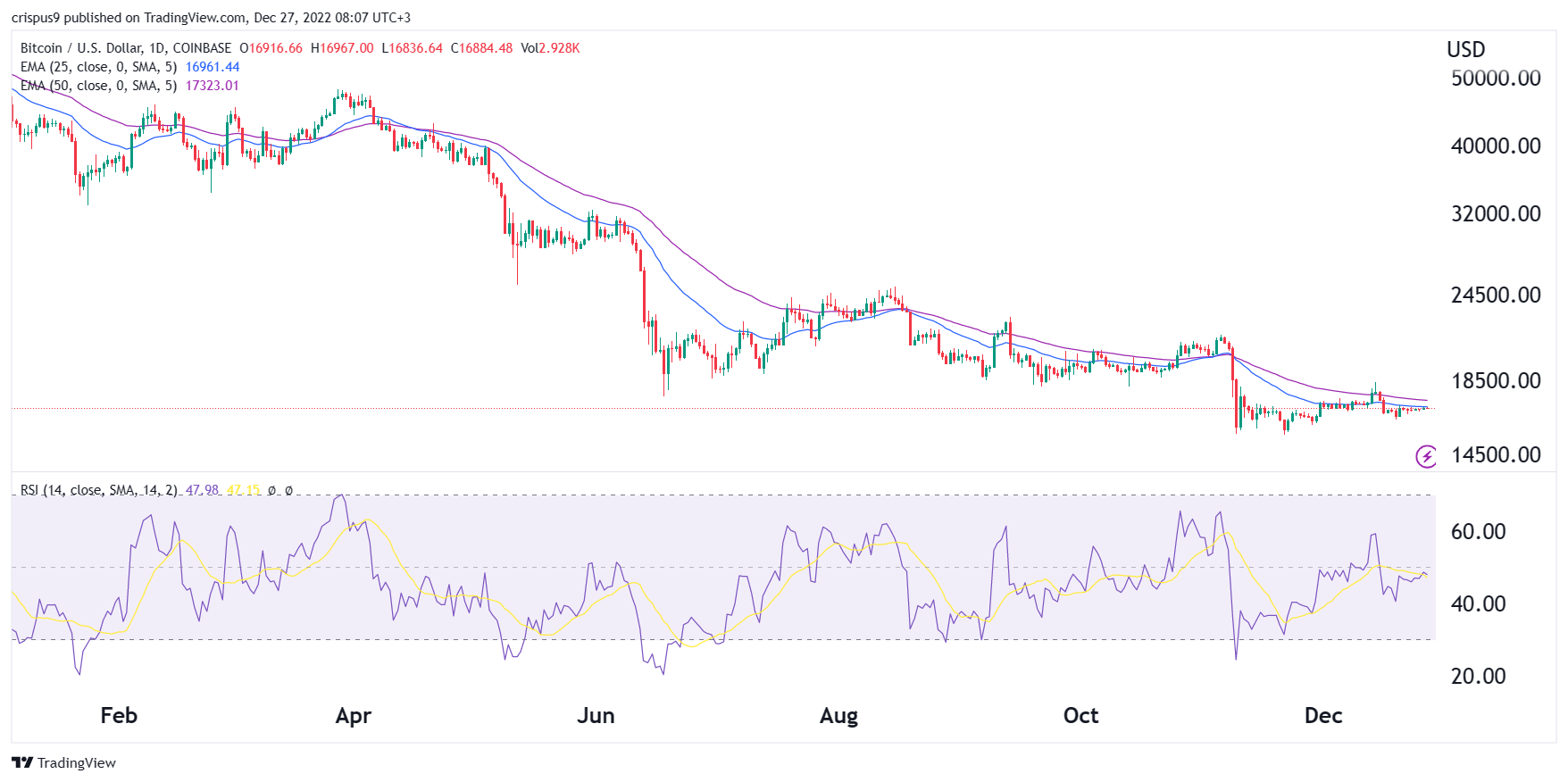
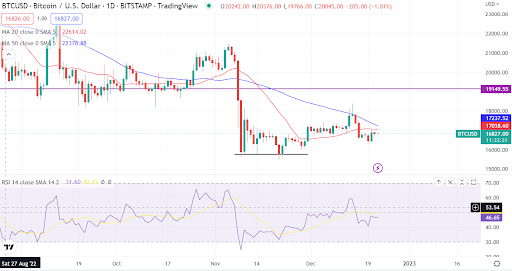
So, is it safe to buy Bitcoin? The BTC price has been in a tight range in the past few days. In this period, it has remained below the important resistance level at $16,867. It is also consolidating at the 25-day and 50-day moving averages. 

At the same time, the Reltive Strength Index (RSI) has formed a bullish divergence pattern, which is a bullish sign. It has also formed a rising wedge, which is usually a bearish sign. Therefore, there is a likelihood that the coin will have a bearish breakout. If this happens, it could drop to $15,000.

The post Bitcoin price recoils as hopes for a Santa rally fade appeared first on CoinJournal.

Bitcoin whales gorge on another $726 million worth of BTC

  • Bitcoin wallet addresses with 100 to 10,000 BTC bought another $726 million worth of coins in 9 days.
  • The sharks and whales activity highlight the continued accumulation of BTC as market navigates the recent FTX- fueled crash.
  • Bitcoin price rose to highs of $18,385 on Tuesday, before retreating late Wednesday following US central bank interest rate hike.

Bitcoin rallied well above $18,000 this week as the crypto market moved higher amid exuberance in the risk asset market over cooling inflation in the US.

The flagship cryptocurrency hit highs of $18,385 ahead of Wednesday’s 50% rate hike from the US Federal Reserve.

While the Fed Chair Jerome Powell’s hawkish remarks helped dampen sentiment to push BTC below $18k again, the crypto remains poised for a fresh upside given bulls’ holding of prices above the key support base established in the aftermath of the FTX implosion.

Whales continue to buy the dip

Bitcoin’s retreat from $18,385 suggests bulls might have to rely on the buffer at $17,200 – the immediate resistance level that’s likely to act as a key support base. Below that, bears could target $15,700.

Despite the rejection at intraday highs above $18,300 seen this week, its likely bitcoin will look to retest the price level given its strong fundamental outlook.

According to o-chain data shared by market platform Santiment, more bitcoin sharks and whales have scooped coins this past week. This happened amid the FTX fallout and as the firm’s data shows, addresses holding 100 to 10,000 BTC have added over $726 million BTC in just nine days.

About 15,900 wallet addresses in this category hold 8.5 million bitcoins worth over $149 billion (at current prices).

Notably, it adds to the accumulation seen since Bitcoin price registered a sharp decline on news of FTX’s implosion in early November. 

As well as whales and sharks, shrimps and crabs have also been grabbing some alpha. The two wallet cohorts have aggressively been buying BTC. As we highlighted here, the group has added more than 96,000 BTC worth over $1.6 billion in 30 days.

The post Bitcoin whales gorge on another $726 million worth of BTC appeared first on CoinJournal.

Why has the Grayscale Bitcoin Trust discount hit an all-time high?


Key Takeaways

  • Grayscale is the largest Bitcoin fund in the world
  • Discount to underlying asset (Bitcoin) has reached record levels, breaching 50%
  • Concern about reserves, higher fees and other hurdles explain the discount, which likely won’t close anytime soon


The discount to net asset value of the Grayscale Bitcoin trust is at all-time highs. The discount briefly pushed past 50%, before pulling back slightly to where it currently sits at 48.8%.  

This comes off the back of the SEC reaffirming its reasons for denying Grayscale’s application to convert the trust into an exchange-traded fund.

 The Grayscale Bitcoin Trust is the largest Bitcoin fund in the world, but it has rarely traded at the same level as its underlying asset, Bitcoin. The above chart shows that it had, until this year, traded at a premium since its launch compared to Bitcoin.

This fund allows accredited investors to gain exposure to Bitcoin without worrying about storing or managing their holdings. It previously traded at a premium as demand for shares surged, with institutions wanting Bitcoin exposure. This convenience does come at a fee, however – and a rather hefty one at 2%.

Demand falls for Grayscale in 2022

Since March, the Grayscale shares have been trading at a discount to Bitcoin. The fund has $10.7 billion in assets under management, a stark 65% fall in the last year, reflecting the bloodbath in the crypto markets.

But the discount to Bitcoin means shareholders are getting hit twice as hard.

“The fact that Grayscale’s Bitcoin Trust is now trading at nearly 50% discount is just awful for holders of GBTC. It really highlights the vast differences in structure quality between different investment vehicles,” Bradley Duke, co-CEO at ETC Group, told CoinDesk last week.  

A decline in inflows has been borne out of greater competition as many competitive funds have launched, especially in Europe, as well as multiple filings for Bitcoin ETFs in the US. The discount is also because investors have no way to redeem their holdings for Bitcoin in the trust, but all the while are being charged a 2% fee.

However, these factors have typically been dulled by arbitrage traders taking advantage of the dichotomy in prices. But happenings this year have reduced that, too.

Concern about Grayscale’s reserves

Over the last month, concern has swelled in the market that Grayscale’s parent company, Digital Currency Group (DCG) may file for bankruptcy. This is due to the issues surrounding crypto broker Genesis, whose parent company is also DCG.

Genesis have denied they will imminently file for bankruptcy, but the firm was caught up in the FTX collapse and is currently undergoing restructuring. Genesis halted withdrawals on November 15th.

This concern has been elevated by questions around Grayscale’s reserves. Namely, whether they are true to their word and are holding all the underlying Bitcoin securely. With many major crypto companies publishing proof of reserves in the aftermath of the FTX crisis in order to assuage customer fear, Gray scale refused.

“Due to security concerns, we do not make such on-chain wallet information and confirmation data publicly available through a cryptographic Proof-of-Reserve, or other advanced cryptographic accounting procedure,” Grayscale wrote in a statement.

As I wrote at the time, I really can’t fathom how security concerns are a factor here. The blockchain is built so that this kind of information is available to the public.

Final thoughts

All in all, the discount sums up investors’ concern around Grayscale, as well as the extra fees and other hurdles which exist compared to owning the underlying. Arbitrage trades are self-destructive by nature, and hence it is notable that the discount is so large and has persisted for so long.

Then again, there is risk here, as the same thing which I have been writing about for a while now – a lack of transparency – means that it cannot be known for 100% certainty what is going on behind the scenes. And that is why we are seeing a 50% discount.

The post Why has the Grayscale Bitcoin Trust discount hit an all-time high? appeared first on CoinJournal.