
What to expect in crypto ahead of inflation report, as Bitcoin banks eight straight days of gains


Key Takeaways

  • Bitcoin has increased for eight straight days, now up 9.2% on the year
  • Period of low volatility in the crypto markets paired with softer inflation data has sent prices upward
  • Latest CPI report is out Thursday which will trigger volatility and is vitally important for the market following increased optimism over last month or so
  • Altcoins could move violently on the report, while Bitcoin will likely shake off its $18,000 mark if data comes in below or above expectation


Bitcoin has banked eight straight days of price rises, as the new year has kicked off assiduously for cryptocurrency investors.

Whereas 2022 brought nothing but pain and freefalling prices, 2023 has thus far been the exact opposite. Bitcoin is up above $18,000 and Ethereum close to $1,400, good for rises of 9.2% and 16.4% respectively year-to-date. Many altcoins are up even more.

Volatility has reduced in the crypto markets

The macro climate is pushing prices upward. I wrote a piece analysing the softer climate last week, but optimism has crept into the market that inflation may have peaked and that the possibility of a pivot from the Federal Reserve off its policy of heightened interest rates may be coming soon than previously anticipated.  

It should be noted that while this is a nice rally, it is hardly a violent breakout. Cryptocurrencies are notoriously volatile and there has actually been an unusual serenity that has washed over markets over the past couple of weeks.

A quick glance at the chart for the daily returns of Ethereum illustrates that there has been a perceptible fall in volatility.

Inflation data to be released Thursday

I write this on Thursday morning, with the all-important US inflation data to be released this afternoon. If we know anything by now, it is that inflation numbers rule the world. If there is anything in the current climate that will produce volatility, it is the CPI report.

As mentioned above, this relief rally has largely been predicated on softer inflation leading to the hope that the Federal Reserve will pivot off its high-interest-rate policy sooner than anticipated. Another positive inflation number would give further impetus to crypto prices. It is not hard to imagine Bitcoin pushing up towards $20,000 and Ethereum to $1,500 if the number comes in cooler than anticipated.

On the flip side, of course, is the potential for the number to disappoint investors. Following two straight months of positive inflation, a step back this afternoon would be a body blow for crypto, and it would not be a surprise to see it drop sharply as all the optimism of the last month gets released in an instant.

The inflation number is expected at 6.5%. This would be a decline from the prior month of 7.1%. Should the number come in at 6.7% or higher, this would represent a major disappointment and crypto will likely freefall. Do not be surprised to see Bitcoin down at $16,500 in this scenario.

The data will be released at 1:30 PM GMT (8:30 AM ET), and it is the last CPI report before the Federal Reserve’s February 1st interest rate decision.

Altcoins showing signs of life

However bad things have been for Bitcoin and Ethereum, the landscape has been a hell of a lot worse for altcoins. Below are the percentage returns in 2022 from the top 10 coins as of 1st January 2022.

As is standard, these coins are significantly more volatile, and trade like leveraged bets on Bitcoin. It follows that this year, the jumps have also been stronger than the number 1 crypto. 

Looking at the top 10 coins from Jan 1st this year, some of the returns have been seismic, albeit from a significantly lower base. Remember, a 90% drop followed by a 50% rise is still the same as an 85% drop from the original starting point. A simple math problem that many investors do not understand. Hence, the past couple of weeks have been positive, but this is still a space that has been absolutely ravaged by the bloodbath that was 2022, and it will take a very long time to recover from. 

Final thoughts

This is a pivotal week for the markets and it will be a true gauge of how far the battle against inflation has come. Central banks have been adamant that inflation is the number one priority, and the consequent interest rate policy has crushed risk assets over the last year.

Things are tough in the markets, but with a third straight month of OK inflation data, it could point toward a light at the end of the tunnel. Then again, the world is teetering on the edge of a recession as it is, and if inflation takes a step back, it will be a double whammy of high rates and still-persistent inflation. As always, risk assets will feel the pain. 

Crypto investors will just have to hope that the pivotal CPI number doesn’t dare tick up beyond 6.5%. 

The post What to expect in crypto ahead of inflation report, as Bitcoin banks eight straight days of gains appeared first on CoinJournal.
Argo Blockchain mined 28% fewer bitcoins in December

  • Argo Blockchain mined 147 bitcoins in December 2022, down from 198 in November.
  • Mining revenue was $2.49 million, compared to $3.46 million during the previous month.
  • Argo sold its Helios facility to Galaxy Digital for $65 million as it looked to avoid nose-diving into bankruptcy.

Argo Blockchain, a leading Bitcoin miner that endured a terrible run in 2022 and came close to bankruptcy, has announced it mined 147 BTC only in December.

The publicly-traded company’s total mined bitcoins for the month were lower than the 198 BTC mined in November — nearly 28% lower than its mining output in November.

Mining revenue came in at $2.49 million (£2.07 million), down from $3.46 million (£2.94 million) in the previous month.  The firm’s mining margin in December 2022 was 48%, compared to 29% in November.

As of 31 December, the miner held 141 bitcoins.

Argo CEO on reduced mining results

According to details provided in the miner’s operational update published on 11 January, the decline in mining revenue (decreased mined coins) was mainly a result of the reduced mining operations following the winter storm that hit the United States in December.

Argo, like many other Texas Bitcoin miners, contributed to the stability of Texas’ power grid by cutting power usage during the storm.

“While our mining results for December were lower than anticipated, the primary driver was the winter storm which led us to curtail operations at Helios. We made this decision in order to not only reduce power usage on the grid, but also to prioritise the needs of the local community and safety of our Helios employees, Argo CEO Peter Wall said in a statement.

Notably, Argo sold its Helios facility for $65 million to Galaxy Digital and also agreed a $35 million loan as it sought to firm its balance sheet. But despite mining fewer BTC in December, and the sale of the Helios facility, Argo’s total hashrate remains around 2.5 exahashes per second (EH/s).

The post Argo Blockchain mined 28% fewer bitcoins in December appeared first on CoinJournal.

Its the calm before the storm in crypto markets


Key Takeaways

  • Crypto volatility has come down and extreme on-chain activity subsided in period of relative calm
  • Several concerning developments around Genesis, Gemini and DCG are still ongoing, however
  • Volatility could also spark up once the US inflation data is revealed this week
  • Period is reminiscent of the low drama environment pre-FTX in October 


After a tumultuous rollercoaster following the shocking demise of FTX, a period of notable serenity has descended upon cryptocurrency markets. 

With 2022 being a complete and utter bloodbath, it almost feels suspicious that there is even a couple of weeks of low drama in the digital market space. 

But the metrics show that the last few weeks have been among the quietest of the last couple of years. Given the fear of contagion that transpired out of FTX’s collapse, that is a good thing. 

Fear still elevated in crypto circles

Having said that, there is plenty to be concerned about right now. As Coinbase CEO Brian Armstrong stated yesterday when he announced Coinbase was cutting an additional 20% of its workforce, there are likely “more shoes to drop” and there is “still a lot of market fear” out there. 

Crypto lender Genesis last week laid off 30% of its workforce and is reportedly mulling bankruptcy. Crypto exchange Gemini, founded by the Winklevoss twins, has $900 million of customer assets stuck in limbo with Genesis, its sole lending partner for its Earn product. 

The twins have demanded Barry Silbert, CEOP of Digital Currency Group (DCG), which owns Genesis, to step down, accusing him of defrauding Gemini Earn customers. 

DCG fired back, calling it “another desperate and unconstructive publicity stunt from Cameron Winklevoss to deflect blame”. It also affirmed it was “preserving all legal remedies in response to these malicious, false, and defamatory attacks).  

DCG is also the parent company of the Grayscale Bitcoin Trust, which has seen a massive discount to its net asset value, peaking at 50% in the aftermath of the FTX collapse as investors questioned whether reserves were safe (I wrote about GBTC yesterday).  

Markets stand firm for now

For now, while all these episodes play out, the markets are standing firm. Action has been relatively muted, and in fact there has been a tangible return to normal levels for a lot of on-chain activity that went wacky over recent periods. 

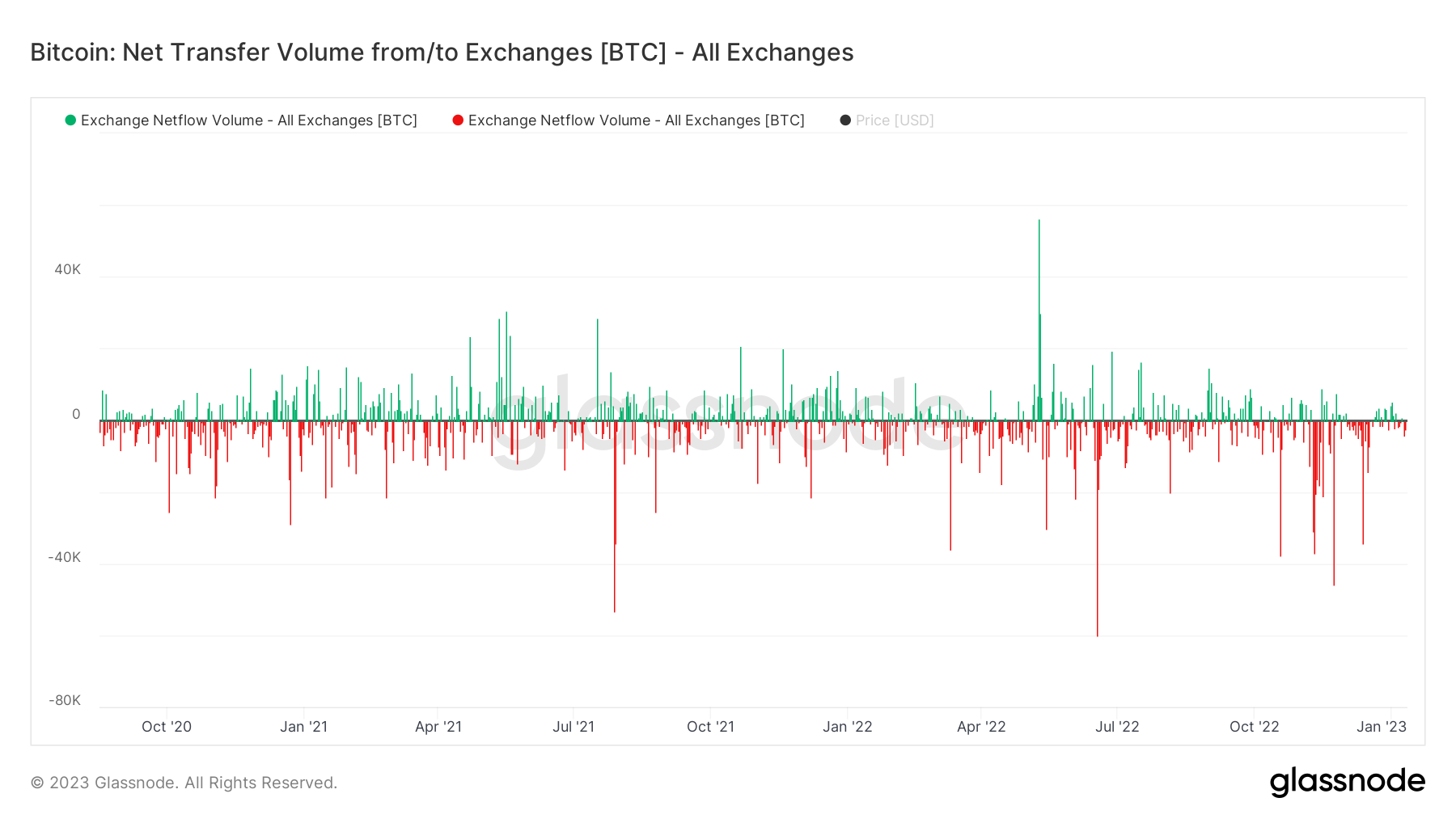
The below snapshot shows the net transfer volume in and out of exchanges. Since the start of the year, the action has been tepid, having spiked to extreme levels in November and December as first FTX collapsed and then the questions spiked about the health of Binance. 

This notion that activity has returned to normal is reinforced when looking a the volatility of Bitcoin. The world’s biggest cryptocurrency has been trading sideways for a while now, and the 30-Day Pearson measure of volatility shows how there was a perceptible drop back down to pre-FTX levels in December. 

Macro climate looking more optimistic

It hasn’t just been a respite from within crypto circles. The broader macro environment is looking at least a bit brighter today than it did last month. Inflation is still rampant, but there have been two consecutive readings below expectation, and there is renewed hope that it may have peaked.

The most recent round of interest rate hikes kicked rates up 50 bps as opposed to 75 bps in the two prior months, and while Fed chair Jerome Powell and other central bank chiefs have affirmed that rates will continue to rise until inflation is conquered, the market has moved cautiously upward after European inflation came in at 9.2%, compared to 10.1% last month.

Next up is the US CPI reading on Thursday, which will – as always – be a vitally important day in markets. Expect volatility in crypto markets as coins stare at the number to try to assess what Jerome Powell may do with regard to interest rate policy.

After all, we know by now that crypto is very much holding the stock market’s hand – apart from when, you know, high-profile executives are revealed to be fraudulent (FTX), or top 10 coins cease to exist (LUNA).

Never a dull moment for long in crypto

Back in late October, Bitcoin was seemingly locked in crab motion around $20,000. With traders getting impatient, I warned how crypto could be one event away from a nasty downward wick. T

Three weeks later, FTX collapsed. I never imagined this would happen, and the timing was coincidental, but the premise of the piece reminds me of how I feel now. It’s amazing how short memories are in markets, but we have been here before.

Crypto won’t stay silent for long, and the asset class is far from out of the woods yet. The aforementioned ongoings around DCG, GBTC, Genesis and Gemini are just a few of the million things that could turn south at any moment.

There is also the story around Binance chief Changpeng Zhao being under investigation for money laundering offences by the SEC, there is Coinbase laying off 20% of its workforce following a 905 drawdown in its share price, and God knows what will come out of testimonies in the Sam Bankman-Fried court proceedings.

And then there is macro, where anything could happen to inflation, the Russian war in Ukraine or myriad other variables. It’s been a quiet couple of weeks but don’t worry – the madness will return soon.

The post Its the calm before the storm in crypto markets appeared first on CoinJournal.

Grayscale Bitcoin Fund up 25% this year, but discount still killing investors


Key Takeaways

  • GBTC Fund is up 25% since the start of the year, compared to a 4% rise in the underlying asset, Bitcoin
  • The discount is now back to where it was prior to the FTX collapse, at 37%
  • The discount had hit an all-time high of 50% only four weeks ago


The largest Bitcoin fund in the world, the Grayscale Bitcoin Trust, has seen its value jump by 25% since the start of the year. Bitcoin, on the other hand, is only up about 4% on the year.

This means that the discount to the underlying asset, Bitcoin, is at its smallest level in months. I had analysed the divergence in December, only four weeks ago, when the discount hit an all-time high of 50%.

Today, the discount sits at 37%, back to where it was before the ignominious collapse of FTX.

What is the Grayscale discount?

Grayscale is a trust which provides an avenue for investors to gain exposure to Bitcoin without physically buying Bitcoin. This can be convenient for institutions or other entities who may not be able to participate I the Bitcoin market directly for regulatory or legal reasons.

But Grayscale has rarely traded at the same price as its net asset value. Previously, it had traded at a premium to the underlying Bitcoin as shares surged with investors desperate to get exposure to the high-flying cryptocurrency.

Today, however, it is the opposite – a steep discount. While there is a chunky fee of 2% that explains some of the discount, this does not come close enough to bridging a discount of 30%+ that we have seen consistently in this crypto winter.

The SEC recently denied Grayscale’s application to convert the trust into an exchange-traded fund, spelling bearish action around the fund. There has also been the rise of more competition, with similar funds being launched, especially in Europe, and filings for Bitcoin ETFs.

But the most significant worry was surrounding the safety of reserves. This issue grew legs after the FTX collapse, as speculation mounted that Grayscale’s parent company, Digital Currency Group (DCG), may file for bankruptcy.

DCG is also the parent company to Genesis, which recently laid off 30% of its staff and is reportedly considering bankruptcy. Concern grew when Grayscale refused to publish a proof of reserves report, suddenly in vogue following the nefarious actions behind the scenes at FTX.

It cited “security concerns” as the reason that this would not be possible, but analysts decried this, with it very unclear what security concerns could be ignited by the publishing of public records on the blockchain.

Why has the discount closed?

While the discount is still enormous at 37%, this has narrowed from the staggering 50% it reached in the aftermath of the FTX implosion.

There has been increasing pressure on DCG to address this discount, with calls from within the industry that the trust should allow investors to redeem their holdings, which would allow them to realise the full value of the Bitcoin they hold. This clamour may have helped narrow the gap somewhat.

One hedge fund, Fir Tree, even launched a lawsuit against Grayscale, demanding that the company either lower its fees or allow redemptions such that the discount can be closed.

But like everything in crypto right now, macro also has a part to play. The year has begun with crypto prices rising off increased optimism that inflation may have peaked. This follows a relatively serene month or so in crypto markets.

The discount widened to a large degree in the aftermath of the FTX crash because people feared contagion and the chips were still falling. Similar to the peg on Tether slipping when the UST crisis occurred.

Now that normal service has somewhat resumed, the discount has narrowed. Unfortunately for investors, it is still a staggering 37% off the net asset value. In a year where Bitcoin itself has plummeted, layering in a discount on top of that torrid price action is the last thing investors needed…

The post Grayscale Bitcoin Fund up 25% this year, but discount still killing investors appeared first on CoinJournal.

Bitcoin could tank further but you might be excited by this Bloomberg prediction

  • Bloomberg report projects bullish Bitcoin in 2023

  • Analysts bank on recession dynamics and central banks’ actions as bull triggers

  • BTC trades on a short-term recovery, with $19,000 in sight

Investors may hold their breath, hoping that 2023 will turn out to be a good year for crypto and stocks alike. But even with these hoped-for expectations, market analysts have warned that 2023 could be the year of a global recession. With the economic depression, notable recoveries may be hard to come by. But Blomberg analysts think a recession would be a bullish trigger for Bitcoin price (BTC/USD). How?

In its cryptocurrency outlook, analysts say Bitcoin will come out ahead in a potential economic shutdown in 2023. Even so, the prediction is not outright. According to the report, Bitcoin could slide to $12,000 or even $10,000. From there, it will stage a strong comeback.

Additionally, the Bloomberg report highlights policy easing in 2023 as a key bullish trigger for Bitcoin and cryptocurrencies. The analysts say central banks could be forced to ease policy on the back of deflationary outcomes. If this happens, the use case of Bitcoin as a digital version of gold will strengthen. The analysts point out that Bitcoin will start performing like the US long-dated treasury bonds and metal. The scenario will be bullish for the digital asset.

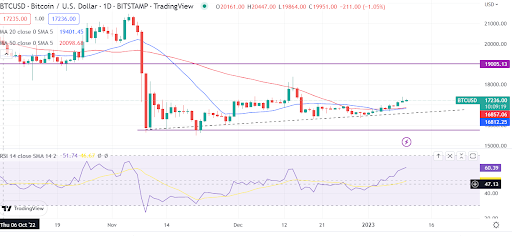
Bitcoin price movement as moving averages join the support

BTC/USD Chart by TradingView

Technically, BTC is mildly bullish and trades along a short-term ascending trendline. The price has, for the first time since November, moved above the 50-day moving average. A potential 20-day MA crossover of the 50-day MA could heighten the recoveries. The RSI reading has safely surpassed the midpoint reading of 50, indicating that buyers are in control.

What is the likely target for BTC?

With the upside, Bitcoin now trades below an overhead and crucial resistance at $19,000. Should the current upside continue, the level is the target zone for buyers. Accelerated recoveries will depend on the prevailing crypto sentiment.

Where to buy BTC

eToro

eToro is a global social investment brokerage company which offers over 75 cryptocurrencies to invest in. It offers crypto trading commission-free and users on the platform have the option to manually invest or socially invest. eToro even has a unique CopyTrader system which allows users to automatically copy the trades of popular investors.

Buy BTC with eToro today

OKX

OKX is a top cryptocurrency exchange which offers over 140 cryptocurrencies to invest in. OKX takes customer security very seriously, they store almost all of their clients‘ funds in cold storage, and the exchange is yet to be hacked. On top of this, the exchange offers very low fees and customers can even use their crypto as collateral for loans on the platform.

Buy BTC with OKX today

The post Bitcoin could tank further but you might be excited by this Bloomberg prediction appeared first on CoinJournal.