
BRC-20 tokens have major flaws and issues, Mintlayer CEO says

  • Bitcoin BRC-20 tokens have skyrocketed over the past few days, with their combined market value rising to over $923 million as of 8 May, 2023.
  • Mintlayer CEO Enrico Rubboli has highlighted some of the flaws and issues plaguing the BRC-20 token standard.
  • Apart from not aligning with the “axioms of the core Bitcoin community,” flaws and issues mean users are likely to be rug pulled.

Crypto news this week indeed has the skyrocketing transactions of BRC-20 tokens as one of the reasons the Bitcoin network experienced massive congestion amid rising fees. 

As CoinJournal highlighted on Monday morning, the crypto market was down as Binance halted BTC withdrawals amid the network congestion. Some of the trending BRC-20 tokens include ordi, pepe, meme, piza and domo. 

Enrico Rubboli, the CEO of Bitcoin sidechain Mintlayer, says that while BRC-20 tokens continue to create a frenzy, there are flaws and other issues that plague the tokens and offshoot decentralised applications that try to connect with smart contracts.

What are BRC-20 tokens?

BRC-20, or “Bitcoin Request for Comment,” is a token standard for Ordinals. The tokens allow for the issuance and transfer of fungible tokens on Bitcoin and hit the market soon after the mainnet launch of the Ordinals Protocol.

With BRC-20 tokens, one can etch digital art references into small Bitcoin transactions. The tokens are a creation of a pseudonymous crypto developer known as Domo.

According to market data for the token category, the combined value of all 11,705 BRC-20 tokens was $923 million as of Monday, 8 May 2023.

BRC-20 tokens plagued by speed and transaction costs issues

Among the insights Rubboli shared with CoinJournal on Monday is that while people pour BTC into minting BRC-20 tokens, there’s a need to realise that the technology behind these assets is “heavily flawed.” He also notes that BRC-20 tokens aren’t “in line with the axioms of the core Bitcoin community.”

Rubboli said that some of the issues currently plaguing the tokens and offshoot dApps within the ecosystem include speed, transaction costs and security.

On the issue of speed, he explains that transactions have to wait for Bitcoin block confirmation before settlement, which when combined with network congestion, has resulted in users waiting hours for transactions to clear.

Mintlayer CEO says BRC-20 tokens are potential rug pulls

According to Rubboli, the use of token bridges and wrapped BTC could expose users to exploits, with DeFi bridges seeing more than $1.4 billion lost to hackers that targeted crypto bridges in 2022. Rubboli believes the entire concept for BRC-20 was designed to confuse and mislead potential investors, with the creators leeching off the popular ERC-20 token standard.

Saying this could be an opportunity for scams, he added:

“The entire ecosystem was set up to be confusing and misleading. BRC-20 was chosen not because it was the 20th proposed standard, but to leech off the popularity of Ethereum’s ERC-20 token. The developers of the standard and the tools are not affiliated with Bitcoin, they are anonymous, and their software has not been thoroughly tested in this application.”

Besides, the hundreds of BRC-20 tokens might not just be totally worthless, but also minted specifically to rug pull later investors. BRC-20 token standard creator Domo has previously warned of the shortcomings of the software, including minting balances to intermediary wallets.

Regulatory issues also arise, with the minting of BRC-20 tokens likely to lead to regulatory concerns around commingling of user-generated tokens with BTC.

“If users mint unregulated securities, it could expose the Bitcoin blockchain to further regulatory scrutiny, which in turn exposes every BRC-20 to regulation due to 1 bad actor. A layer 2 solution fixes this problem as tokens are not commingled with Bitcoin,” he opined.

A layer 2 solution is a protocol that runs on top of a layer 1 blockchain, for instance Bitcoin or Ethereum. The key features that these protocols bring to the L1 include improved scalability and privacy among others. 

In blockchain, common layer 2 solutions include state channels, sidechains, and zero knowledge roll-ups.

The post BRC-20 tokens have major flaws and issues, Mintlayer CEO says appeared first on CoinJournal.
Trillion dollar coin could be good news for Bitcoin, Cardano, Solana

  • The US government could be forced to print a $1 trillion coin soon.

  • Democrats and Republicans are yet to reach an agreement on a debt ceiling.

  • Analysts expect that the two sides will ultimately reach an agreement.

The US government is at a crossroads as divisions in Congress put the country at an elevated risk of a default. In a recent statement, Janet Yellen, the Treasury Secretary warned that the American government could default in June if Democrats and Republicans fail to reach a deal. This is one of the top reasons why gold price has now soared to an all-time high.

The trillion-dollar coin

It is still unclear whether the US will default on its obligations if Congress fails to raise the debt ceiling. I believe that the situation will not get to that point because of its impact to the American economy. 

Analysts believe that a default will lead to higher unemployment and possibly the collapse of the economy as we know it. 

Therefore, the two sides will likely reach an agreement in the coming days. Signs of potential compromises will happen when Biden will meet Kevin McCarthy on Monday.

There are several options if the two sides fail to raise the debt limit. A likely solution will be to print a trillion dollar coin. The concept of that coin was mooted in 2011 when the US faced another debt ceiling issue. 

It would allow the Mint to come up with one platinum coin valued at $1 trillion. These funds would then be distributed to the Federal Reserve, which would then deposit it to the National Treasury. By doing that, the Treasury would then elimiate part of the national debt and postpone the need for raising the debt ceiling. A professor at Willamette University said:

“At this point, if any of the other solutions, the so-called more serious solutions would work, then they would’ve been used by now. But they keep not actually being strong enough. The coin’s the only one that’s strong enough.”

Bullish for Bitcoin, Solana, Cardano

Such a move would be positive for Bitcoin, which is seen as a digital version of gold. Unlike fiat currencies, Bitcoin cannot be printed because its supply of 21 million coins cannot be adjusted. If Bitcoin rises, we could now see altcoins like Solana, Cardano, and Tron rise because of the close correlation that exists.

The reality is that the American government is at risk of major changes going forward. For one, the total public debt has been in a strong upward trend in the past few years. It has jumped from just $320 million in 1970 to over $31.4 trillion today. 

And the situation will continue worsening because of the large budget deficits. By 2030, analysts expect that debt will rise to over $44 billion. The CBO believes that the budget deficit will hit 5.9% of GDP by 2040.

How to buy Bitcoin

eToro

eToro is a global social investment brokerage company which offers over 75 cryptocurrencies to invest in. It offers crypto trading commission-free and users on the platform have the option to manually invest or socially invest. eToro even has a unique CopyTrader system which allows users to automatically copy the trades of popular investors.

Buy BTC with eToro today

Bitstamp

Bitstamp is a leading cryptocurrency exchange which offers trading in fiat currencies or popular cryptocurrencies. Bitstamp is a fully regulated company which offers users an intuitive interface, a high degree of security for your digital assets, excellent customer support and multiple withdrawal methods.

Buy BTC with Bitstamp today

The post Trillion dollar coin could be good news for Bitcoin, Cardano, Solana appeared first on CoinJournal.

Why is the crypto market down today?

  • The crypto market cap was down 3.2% in the past 24 hours to $1.2 trillion as Binance halted BTC withdrawals.
  • The exchange’s action followed massive network congestion for Bitcoin amid increase in fees as tokens with inscriptions and ordinals pumped.
  • Meanwhile, Bitcoin (BTC) saw its market cap drop to $540 billion for a 45% market dominance.

The total cryptocurrency market cap is down 3.2% to $1.2 trillion in the past 24 hours as of writing. The top two digital assets by market capitalization Bitcoin (BTC) and Ethereum (ETH) are both down more than 3% in the same period and -5.4% and -2.2% respectively over the past seven days.

As a result, BTC price is below $28,000 while Ether is trading near $1,850 amid broader selling pressure for crypto.

While most big cap tokens are down about 3 to 6%, Pepe (PEPE) and Sui (SUI) are the biggest losers in the top 100 coins with about -12% performance in the past 24 hours.

Why crypto market is down today – look at Bitcoin

The traditional markets continue to see some negativity as traders place new bets on regional banks plummeting again following last week’s bounce. The outlook isn’t the same for crypto and Bitcoin indeed rallied as multiple US bank stocks dumped.

But why is the crypto market cap down? Notably, crypto remains volatile and BTC is finding it difficult to break higher following the rejections near $30,000. However, panic selling could be behind this latest down leg, particularly with such data as the one showing enormous BTC outflows from the Binance exchange. 

Binance addressed the “outflows” funds movement between its hot and cold wallets amid the adjustments in BTC address. This comes after the exchange suspending Bitcoin transactions as the flagship network experienced massive congestion. It’s a scenario that saw transaction fees spike significantly.

For instance, on Sunday, transaction fees in BTC block 788695 was 6.7 BTC, higher than the block subsidy of 6.25 BTC. On-chain data shows Bitcoin experienced a spike in blockspace demand, pushing transactions fees higher.

According to on-chain analytics platform Glassnode, the high demand for blockspace is being driven by BRC-20 tokens. The tokens that use inscriptions and ordinals have been up as shown by the 9% gains for Stacks (STX) amid BTC price decline.

As such, the Bitcoin market cap is down to $540 billion today, representing about 45% of market dominance. Ethereum‘s market dominance currently stands around 18.6%

Bitcoin price prediction

The announcement that Binance had suspended BTC withdrawals – on two occasions – looks to have spooked a few traders into action. But the crypto market cap could recoup some of the losses ahead of a crucial week with economic news. Binance is also reportedly eyeing Bitcoin Lightning Network transactions.

Crypto analyst Michael van de Poppe highlights Bitcoin price levels at $27.4k or even $26.8k could provide the bounce area.

“Mentioned before that $29.2K was the key level to break for #Bitcoin. We did have a bounce towards it, but no break. Additionally some FUD regarding #Binance doesn’t help. Looking at $27.4K or $26.8K for potential longs towards the CME gap at $29.6K,” the analyst tweeted on Monday morning.

The post Why is the crypto market down today? appeared first on CoinJournal.

Should you buy Block stock on a boost to bitcoin revenue in Q1?

  • Block didn’t see an impairment loss on its bitcoin holdings in Q1.
  • Analysts at KeyBanc continue to see upside in its shares to $85.
  • Block stock is currently down about 5.0% versus the start of 2023.

Block Inc says it did not see an impairment loss related to its bitcoin hoard in the first financial quarter. Shares are trading up in extended hours.

Bitcoin price recovery helped

The surge in BTC this year pushed the fintech company’s bitcoin revenue in Q1 to $2.16 billion – up 18% sequentially and a whopping 25% versus the same quarter last year.

Gross profit from bitcoin holdings also increased 43% versus the previous quarter, as per its letter to shareholders. Block generated $770 million of total gross profit in its recently concluded quarter – up 16% on a year-over-year basis.

The fair value of its position in bitcoin was $229 million as of March 31st versus the original purchase price of $220 million.

Year-to-date, Block stock is down about 5.0% at writing.

Should you buy Block stock now?

Block ended the quarter with 20 million monthly active users on “Cash Card” – up 34%. Earlier this week, K33 analyst Vetle Lunde noted the similarity in how bitcoin is performing this year and how it recovered after the bear market of 2018-2019.

If it continued on the same trajectory, he added, bitcoin could be worth as much as $45,000 in the coming weeks which could be a significant benefit to Block Inc both in terms of its financial performance as well as the share price.

Those interested in buying Block stock today should also know that analysts at KeyBanc continue to see upside in it to $85 – up roughly 40% from here.

Other notable bulls of the financial technology company include Cathie Wood – the Founder and Chief Executive of Ark Invest.

The post Should you buy Block stock on a boost to bitcoin revenue in Q1? appeared first on CoinJournal.

Will Stacks price go back up? Here’s the short-term outlook for STX

  • Stacks price has declined 4% in the past 24 hours and is -15% this past 30 days.

  • STX currently trades near $0.78, and has a key supply zone near the psychological $1.00 level.
  • The price of STX rose sharply in February and March as the Ordinals hype hit the market.

The price of Stacks (STX) made another higher low move on Wednesday, trading to highs of $0.82 after surging double digits alongside Bitcoin (BTC). The upside followed the crypto market’s upward reaction to the US Federal Reserve’s interest rate hike.

But as the FOMC tide cools, STX is down 4% in the past 24 hours, cutting weekly gains to just 5% and wiping out gains from key price bursts in April.

Will Stacks go back up after the recent dump?

Stacks (STX) is a digital asset that has shown considerable fluctuations in price in the past few weeks. As CoinJournal highlighted in this article, the main driver of Stacks price in February was the strong interest in Ordinals, a platform for Bitcoin inscriptions (crypto assets similar to NFTs).

Stacks, which brings the power of smart contracts to Bitcoin, also surged in March as whales loaded up on the native STX.

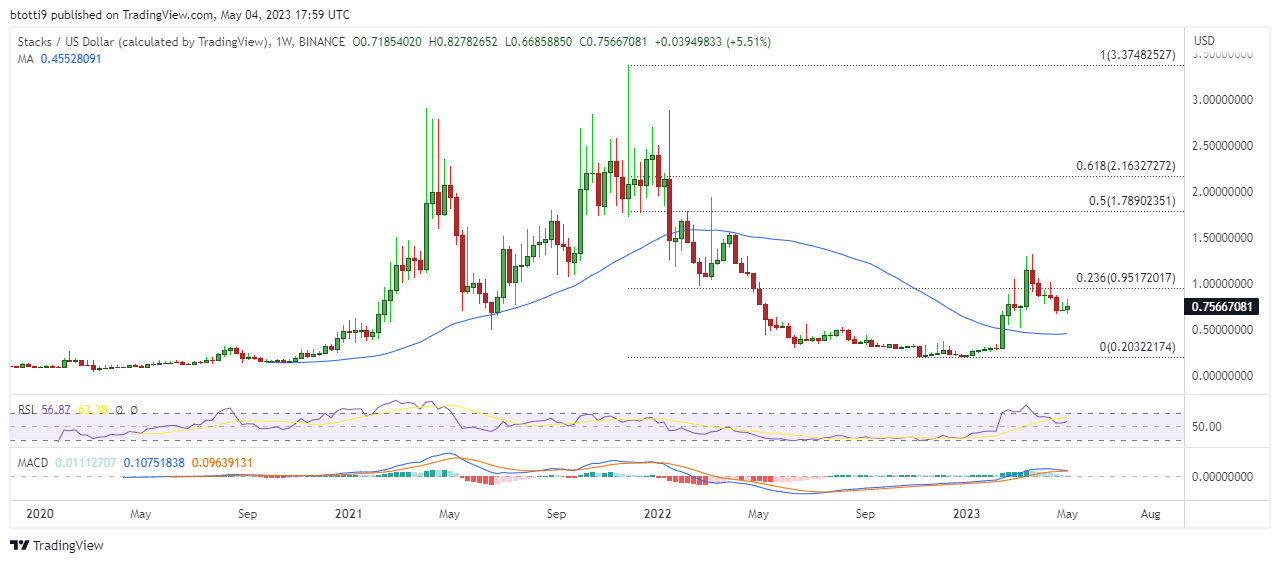
As seen on the weekly chart below, STX/USD has been constrained between robust support at $0.64 and new resistance near $1.33 since 20 February. The coin is up 5% this week but is in the red on the monthly chart after today’s declines helped erase gains made earlier in the year. STXUSD is down nearly 15% over the past 30 days.

Incidentally, STX rose 122% in one week in February and another 51% over seven days in mid-March. So the question is: will Stacks go back up after retreating from year-to-date highs above $1.32? 

The surge in Bitcoin ordinals, which on-chain data shows reached over 3.5 million this week, suggests interest in the inscriptions is still high. The activity on the Ordinals Protocol and other layer 2s on the Bitcoin blockchain and the potential uptick in BTC price are likely to be major catalysts of upside momentum for the altcoin.

Below is the outlook for Stacks price from a technical perspective.

Stacks price: short term outlook for STX

For a short-term technical outlook for STX, we can look at its weekly chart focusing on the Relative Strength Index (RSI), Moving Average Convergence Divergence (MACD), and Fibonacci retracement levels.

Chart showing the price movement of Stacks (STX) with key technical indicators. Source: TradingViewAs shown above, the RSI indicator for STX on is currently at 57. This suggests that STX is largely neutral, indicating its neither oversold nor overbought. 

However, the MACD indicator is suggesting a potential bearish crossover. We can see the MACD line is above the signal line but could cross below to give the advantage to the bears.

Meanwhile, the main barrier to the upside is likely to be at the Fibonacci retracement level at 23.6% that marks the retracement of the last swing from the highs of $3.37 to lows of $0.20. That level is currently around $0.95. Stacks also highlight the 50% and 61.8% retracement levels as main resistance areas.

In case the Stacks (STX) price continues its downward trend, the first support level could be at a long-term horizontal line near $0.45. The 50-week moving average line is currently leveling up around this area, while the $0.20 demand reload line provides a key buffer zone.

The post Will Stacks price go back up? Here’s the short-term outlook for STX appeared first on CoinJournal.