Anthony Pompliano expects SEC to eventually approve a Spot Bitcoin ETF

  • Pompliano says underlying fundamentals of Bitcoin are strengthening.
  • He expects a Spot Bitcoin ETF to be a meaningful catalyst for BTC.
  • Bitcoin is currently up a whopping 85% versus the start of the year.

Anthony Pompliano agrees that Bitcoin could see friction in the near term but remains bullish on the digital asset for the long term.

Pompliano shares his view on Bitcoin

The Founder of Pomp Investments is constructive because the underlying fundamentals related to the world’s largest cryptocurrency by market cap are improving.

Bitcoin is anti-fragile. We see hash rate hitting all-time highs. We see adoption hitting all-time highs. People are realizing its value and they’re putting all sorts of capital into the network.

The total supply of Bitcoin is slated to halve in April of 2024 which has historically served as a catalyst for its price.

At writing, BTC is already up about 85% versus the start of the year.

Is a Spot Bitcoin ETF coming soon?

Pompliano is also convinced that the U.S. SEC will eventually approve a Spot Bitcoin ETF which will likely be another tailwind for the cryptocurrency.

His comments follow a recent wave of applications for such an exchange-traded fund that the regulator has already dubbed inadequate. Still, Pompliano said today on CNBC’s “Squawk Box”:

It’s a small detail that is more of a formality. We’re watching Wall Street saying we want access to BTC. So, when it [spot bitcoin ETF] happens, a lot of people will pour capital into it.

He’s confident in particular because among notable names that have recently filed for a Spot Bitcoin ETF is BlackRock that has a history of going for an exchange-traded fund only when it’s convinced it will get approval.

The post Anthony Pompliano expects SEC to eventually approve a Spot Bitcoin ETF appeared first on CoinJournal.

Belarus planning to ban P2P crypto transactions

  • Belarusian President Alexander Lukashenko in 2022 signed a decree allowing free circulation of cryptocurrencies like Bitcoin in the country.
  • The announcement somewhat seems to contradict the previous stand that Belarus has had on cryptocurrencies.
  • If effected, Belarusians will not be allowed to use peer-to-peer crypto exchanges.

The foreign ministry of Belarus is drafting new legislation to outlaw peer-to-peer (P2P) cryptocurrency transactions of cryptocurrencies like Bitcoin.

On July 2, the Republic of Belarus’ Ministry of Foreign Affairs (MFA) made a formal announcement on Telegram regarding the new legislation that will outlaw peer-to-peer (P2P) cryptocurrency transactions for individuals.

Belarus’ Ministry of Foreign Affairs (MFA) announcement runs somewhat afoul of the recent laws that Belarus has passed. President Alexander Lukashenko of Belarus officially endorsed the free circulation of cryptocurrencies like Bitcoin in 2022.

Belarus cites high rate of cybercrime

The authorities cited Belarus’ high rate of cybercrime and claimed that since the year’s beginning, local prosecutors have stopped 27 citizens from offering “illegal crypto exchange services.”

The total earning from illicit earnings totalled about 22 million Belarusian rubles ($8.7 million).

According to the foreign ministry, cryptocurrency P2P services are “in demand among thieves who cash out and convert stolen funds and transfer money to criminal scheme organizers or participants.”

The MFA will forbid individuals from P2P and only permit them to exchange cryptocurrencies only through cryptocurrency exchanges registered with Belarus Hi-Tech Park in order to eradicate such illicit activity (HTP). It also stated that it intends to implement a practice that will make it “impossible to withdraw money obtained from illegal activity,” similar to the process for exchanging foreign currencies.

The post Belarus planning to ban P2P crypto transactions appeared first on CoinJournal.

North Carolina lawmakers approve bill seeking study on state adoption of Bitcoin

  • The “State Precious Metals Depository Study” bill received bipartisan support and passed 75-38.
  • North Carolina could look into adding Bitcoin to its State Treasury if the bill is passed.
  • In May, the house voted for another bill that seeks to ban CBDCs in the state. 

North Carolina’s lower house has passed a bill that could see the state initiate a study into the potential benefits of the state’s Department of State Treasury adopting Bitcoin.

North Carolina seeks to add BTC to treasury

The “State Precious Metals Depository Study” bill outlines the custody, insurance and liquidation of crypto assets held by the state. It passed 75-38 with bipartisan support and will now be debated in the Senate.

If passed, it will open the path for BTC and gold to be considered as assets that can be added to North Carolina’s funds. Specifically, the house’s approval puts North Carolina one step towards adding Bitcoin to the state’s holdings. 

“This is a very important step to a more formal acknowledgement of #bitcoin in North Carolina. Lots of behind the scenes work,” said Dan Spuller, Head of Industry Affairs at Blockchain Association.

Spuller noted that the passage of HB721 marks the second time a bill pushed by the North Carolina Blockchain Initiative has received bipartisan support in the General Assembly in 2023.

In early May, the house unanimously passed HB690, a bill that banned the use of central bank digital currencies (CBDCs) in payments in the state. The bill also bans North Carolina from participating in any testing of CBDC.

The state of CBDCs globally

A recent survey showed that 130 countries around the world were in various stages of development towards a central bank issued digital currency. According to US-based think tank Atlantic Council these countries included all G20 members.

As highlighted here, China’s CBDC pilot continues and has support from country’s major banks. Meanwhile, India and Brazil are set to launch their versions in 2024. 

The European Central Bank is also looking to begin a pilot for the digital euro and the UK is exploring its “Britcoin” project. In the US, work on a CBDC is advancing only on its use at bank-to-bank level, with the retail digital dollar largely stuck.

The post North Carolina lawmakers approve bill seeking study on state adoption of Bitcoin appeared first on CoinJournal.

Crypto Fear and Greed Index Points to Bitcoin Price Path to $40K

  • The crypto fear and greed index has moved to the greed area of 62.

  • Bitcoin price has more upside in the next few weeks to hit $40k.

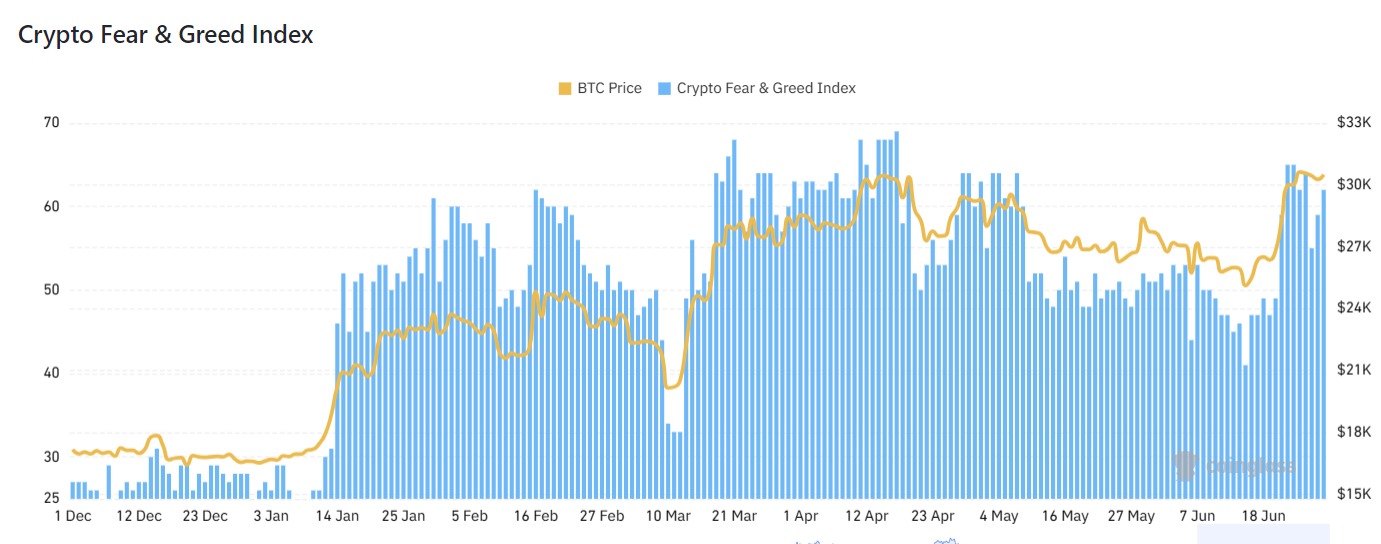
Crypto fear and greed index has moved to the greed area ahead of the upcoming Bitcoin options expiry. Bitcoin price was trading at $30,392 on Wednesday, where it has been in the past few days. This price is a few points below the year-to-date high of $31,478. At its peak, the coin jumped by more than 104% from the lowest level in 2022.

Fear and greed index points to greed

The crypto fear and greed index has made a strong recovery in the past few weeks. It has moved from the fear zone of 41 to the greed area of 62. This means that investors are getting modestly greedy helped by the recent ETF news. The most recent Bitcoin news came on Tuesday when Fidelity announced that it had filed its ETF proposal with the SEC.

Investors believe that a spot ETF will lead to more demand for Bitcoin from institutional investors. Still, this view should be taken with a grain of salt since ProShares Bitcoin Strategy ETF (BITO) has had modest growth in the past few years. It now has about $1 billion in assets. While BITO tracks Bitcoin futures, it has a close correlation with Bitcoin itself.

The fear and greed index points to more upside for Bitcoin since investors tend to buy it when there is greed in the market. Perhaps, these gains will happen ahead or after the upcoming Bitcoin options expiry scheduled for Friday this week. 

Data shows that most of these options are calls with a strike price of about $30,000. This explains why Bitcoin has barely moved this week.

Bitcoin price prediction

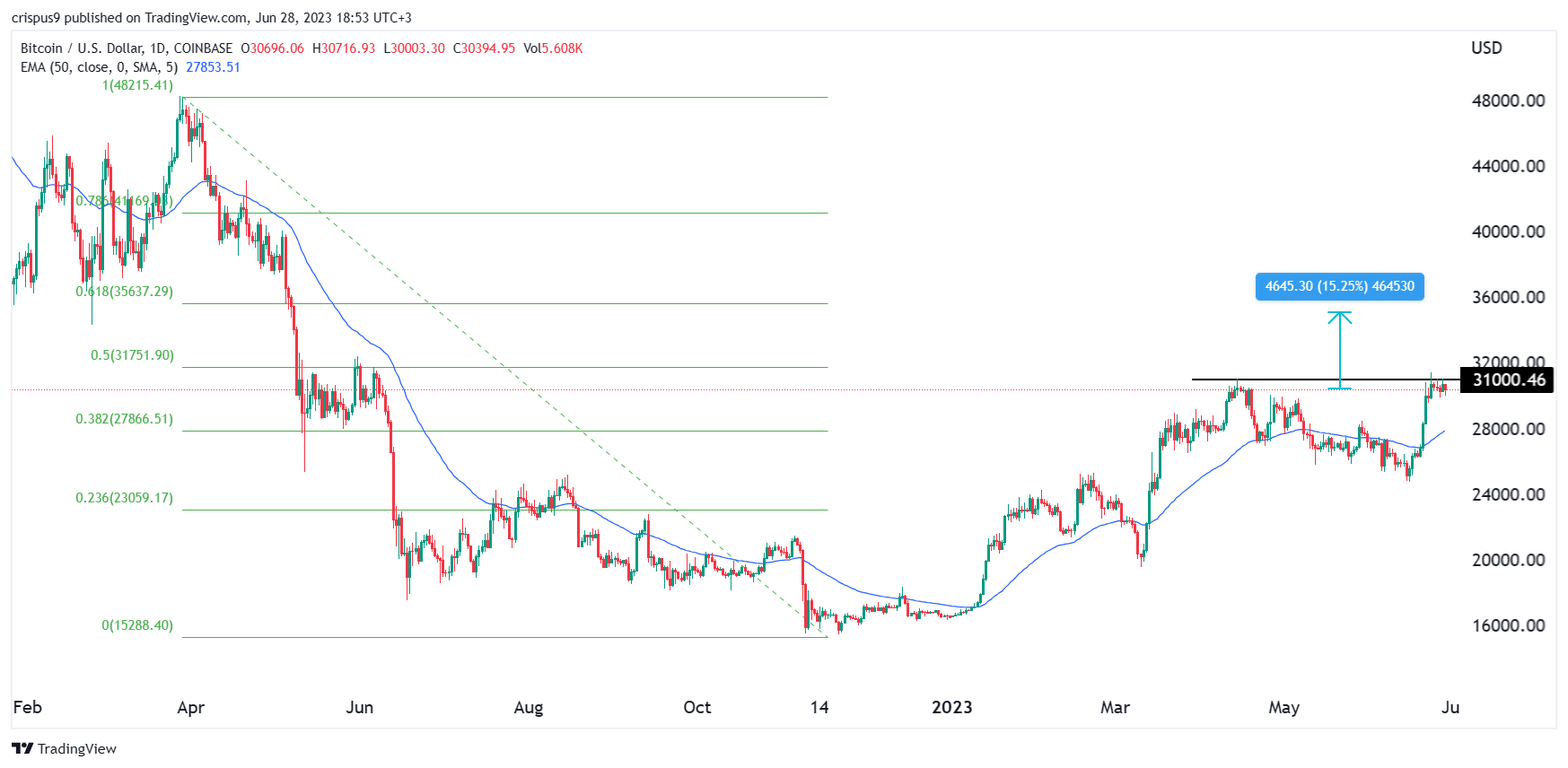
A good technical analysis can help you predict the next price action of a cryptocurrency or other assets. Turning to the daily chart, we see that Bitcoin is oscillating at the 50% Fibonacci Retracement level. This is an important level that traders look at.

At the same time, this is an important price since it was the highest point on April 14th. Most importantly, the coin has formed what looks like a bullish pennant pattern. Therefore, there is a likelihood that the price will soon have a bullish breakout as buyers target the next key level at $35,000. This price is about 15% above the current level. A move above this level will see it jump to the next resistance point at $40,000.

The post Crypto Fear and Greed Index Points to Bitcoin Price Path to $40K appeared first on CoinJournal.

Bitcoin correlation with gold drops, highlighting risk-on nature remains


Key Takeaways

  • Bitcoin’s correlation with gold is currently at its lowest level since FTX collapsed in November
  • Our Head of Research writes that while one day Bitcoin may become a store of value, the numbers say it currently trades like an extreme risk-on asset
  • Bitcoin lost 76% of its value amid the pullback in risk assets once central banks around the world transitioned to tight monetary policy amid the inflation crisis
  • Meanwhile, gold traded flat and is currently close to all-time highs
  • Bitcoin’s correlation with growth stocks and riskier sectors of the stock market remains tight

One of the ultimate bull scenarios for Bitcoin is that it morphs into some kind of digital gold. 

For whatever reason, humans have been obsessed with this weird, shiny metal for thousands of years. Stories date back even further, but we have concrete evidence that gold was an important symbol of wealth in Ancient Egypt in 3000 BC, as well as part of everyday life and mythology. 

Bitcoin, on the other hand, was not around in Ancient Egypt. Nor was it around for the Middle Ages, the Great Depression in the early 20th century, a World War (yet?), the inflation and energy crisis of the 1970s, and it even missed most of the subprime mortgage crisis of 2008. 

In fact, Bitcoin was launched in January 2009, the Genesis blocked mined only two months before the stock market bottomed. Over the next twelve years, not only did the stock market recover, but it went absolutely bananas. Between the 2009 trough and the peak at the end of 2021, the S&P 500 multiplied 7X while the Nasdaq jumped nearly 13X. In other words, Bitcoin was launched into one of the most explosive and longest bull markets in history. Until 2022, it had never known anything but basement-level interest rates and up-only markets. 

Gold’s hedge properties are what Bitcoin seeks

Once 2022 came, risk assets sold off. The Nasdaq shed a third of its value; the S&P 500 fell 20%. Bitcoin had dipped plenty before, but make no mistake: this was the first time it was staring a bear market in the wider economy in the face.

 Despite certain enthusiasts claiming Bitcoin would act as a hedge asset, this did not happen. By the end of 2022, Bitcoin was 76% off its high. In the most explosive inflationary environment since the 1970s and Bitcoin’s first bear market, the asset was getting crushed. There was no debate: Bitcoin was trading like a risk-on asset. And today, it still is.  

That is not to say that the narrative could flip in the future. Personally, that is what I view as Bitcoin’s upside: a store of value akin to gold. But while we can debate whether that may one day happen, it is unequivocal that Bitcoin currently trades like a risk-on asset. These are the facts of the case, and these are undisputed, to borrow Kevin Bacon’s phrase from the absolute classic that is A Few Good Men. 

Gold, on the other hand, traded flat during 2022, and is currently trading close to all-time highs. 

Bitcoin and gold correlation dipping

For all the reasons discussed above, the correlation between gold and Bitcoin is particularly interesting to track. Using the 60-Day Pearson indicator, I have plotted it on the below chart. 

Immediately, the past month jumps out. The correlation was a near-perfect 0.86 at the start of June, and had been around this level since late April. And then, it fell. It currently sits at 0.16, the lowest mark since FTX collapsed in November, sending the crypto market into a tailspin. But why?

Well, I don’t really know. And that is kind of the point. Bitcoin, as it tends to do sometimes, is rising at the moment. Most likely, this is due to news of asset managers Blackrock and Fidelity filing ETFs, but maybe it’s just Bitcoin doing its thing. Perhaps it is merely bouncing back from the sharp fall it took after the Binance and Coinbase lawsuits were announced back-to-back two weeks ago. 

But if we stretch out the time horizon on the previous graph, we see that the correlation between gold and Bitcoin bounces around a lot.

It is challenging to put any pattern on that, to say the least. I thought I might try a different metric, so in the next graph I have used 90-Day Pearson instead of 60-Day. Predictably, the trend is less volatile, but there still appears to be no meaningful relationship here. 

I think it’s pretty clear that assessing the correlation coefficients directly proves that there is zero positive relationship between these two assets. 

Federal Reserve holds the key

In truth, I believe this actually says more about gold than Bitcoin. Gold is in a funny place at the moment, trading more off expectations of inflation and interest rate movements rather than current conditions. The correlation between gold and the stock market is therefore higher than what we have typically seen in the past. This is why we are seeing gold often advance when soft CPI numbers are announced, or when dovish Fed comments surface regarding interest rate policy.

If we step back and look at the big picture, it really is not complicated. Bitcoin has gone from $68,00 in November 2021, when money was cheap and risk assets were trading at outrageous valuations, to $15,500 last November, seven months into the swiftest hiking cycle in recent memory and the worst inflation crisis in 50 years. Then, it doubled to $30,000 as inflation numbers fell away and expectations around the length of the hiking cycle softened. 

Along with all the fakeouts and reverberation in between, that is a hell of a lot of movement and clearly trading like an extreme-risk asset. Meanwhile, gold has been far less volatile, relatively range-bound between $1,600 and $2,000 for three years now. 

Again, while Bitcoin may one day seize the crown of an uncorrelated asset, or a portfolio hedge to inflation, that is clearly not the case today. The below chart is the simplest method of all to show this, plotting Bitcoin’s hand-in-hand relationship with the tech-heavy Nasdaq composite since the economy transitioned to this risk-off, tight monetary policy period. 

A few months ago, Bitcoin rose during the banking crisis, sparking some to declare it as decoupling from risk assets and the fiat world. As I wrote back then, this is nothing more than wishful thinking. Rather, it moved off expectations that the Fed would not be able to hike as aggressively in future if banks were going under due to the strain of these higher rates (indeed, soon after, the correlation rose back up).

The latest dip in correlation with gold, falling back down from the ultra-high 0.86ish value it has been for six weeks or so, is similar. There is nothing ambiguous about the situation at the moment – Bitcoin is trading like a risk-on asset. It may one day claim that coveted title of digital gold, but right now it is nowhere near.

The post Bitcoin correlation with gold drops, highlighting risk-on nature remains appeared first on CoinJournal.