Olympus (OHM) hits point of no return, dips nearly 95% from all-time highs

Olympus (OHM) is closely edging towards the point of no return as downward pressure on the price continues to persist. The DAO token is falling sharply, and as sentiment in the market continues to favour a risk-off mentality, it may take a lot of time before OMH recovers. Here are some notable highlights:

At the time of writing, OMH was trading at $64.81, down about 4% in 24-hour intraday trading.

Also, Olympus (OHM) is now trading at over 90% lower from its all-time highs.

The crypto market crash is likely to make the price action even worse, with negative pressure expected in the coming days.

Data Source: Coinmarketcap.com 

Olympus (OHM) – Can it recover?

Many coins have tumbled in the market over the past few weeks. Some are even way lower than all-time highs. So, this is not something unique to Olympus (OHM). But it is worrying to see such a speedy drop in fact, at press time the coin was trading nearly 95% from all-time highs. 

However, even amidst these headwinds, the project has been trying to build up, launching a new 12-month plan designed to usher in a “stronger ecosystem”. Whether this will do anything to lift the downward pressure remains to be seen. But so far, it looks like OMH may be getting into the point of no return.

Should you buy Olympus (OHM)?

Olympus (OHM), for those of you who don’t know about it, is a platform designed to incentivise users to stake the native OHM token. The hope is that OHM will grow to become a crypto reserve, the same way the US dollar is. This sounds a bit far-fetched but when the project launched, it had a huge following. At the moment, it may not be the right time to buy Olympus (OHM) given the headwinds in the market.

The post Olympus (OHM) hits point of no return, dips nearly 95% from all-time highs appeared first on Coin Journal.

Is $1.5 the next low for Fantom (FTM/USD)?

  • FTM/USD is down 7.83% in the past 24 hours and 33% in the last seven days
  • The crypto token sits at the support of $2.0 in a bearish market
  • $1.50 is the next support level if FTM/USD breaks below the consolidation zone

Fantom’s token FTM/USD has been on a strong rally since December 21, when all other cryptocurrencies were experiencing major weaknesses. It rose from a low of around $1.35 on December 21 to a high of $3.37 on January 17.

However, the token faced bearish pressure and has been dropping since then. At the current trading of around $2.0, FTM/USD has dropped by more than 7% in the past 24 hours, extending losses in the week to at least 33%.

FTM/USD technical analysis – $2.0 is the established support

Source – TradingView

Looking at the daily chart above, FTM/USD has retreated to the support of $2.0. It attempted to rebound before retesting the support again in price weakness that has engulfed the entire cryptocurrency industry. The overall weakness has been connected to the upcoming policy tightening by Fed aiming to tame the rising inflation.

Although FTM/USD is rebounding from the support, it still faces bearish pressure, with the 9-day, 14-day, and 20-day providing resistance. A short-term resistance also exists at the $2.39 level and could constrain prices. We need to watch the close of the candlestick on the daily chart to confirm a trend reversal or continuation.

Summary

Based on the technical pointers, FTM/USD presents a buying opportunity if the $2.0 level holds. A price action signal such as the formation of a bullish pin bar at the support could signal a trend reversal and take FTM/USD higher.

Nonetheless, FTM/USD could break below the support if crypto weakness continues. A break below the current level would see the token claim the $1.5 zone, which is the next support.

The post Is $1.5 the next low for Fantom (FTM/USD)? appeared first on Coin Journal.

Should you buy Shiba Inu as the price get stuck along the support

5 Reasons Why You Should Buy Shiba Inu Today for 2022 Gains

Weak volatility and average momentum are some of the most influential factors that alter the general market sentiment. And to be able to distinguish between a trending market and a range-bound market, you ought to understand the volatility condition of the market.

In general, strong market volatility aided the price action of the meme coin to plunge against the US dollar. And why you might be wondering about what reward you stand to gain when you buy SHIBA INU. Read below to discover the reason why Shiba Inu should be considered as a good buy asset.

Technical levels to watch before buying Shiba Inu

Source – TradingView

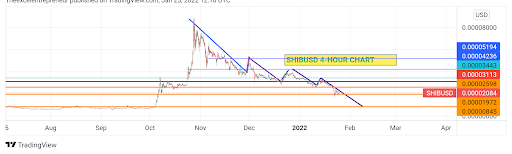
From the 4-hour chart, the price action of the meme coin has been plugging to the South after printing a series of lower highs into support.

In addition, the price of the asset couldn’t stop the sellers from plummeting its value downward after a strong bearish pressure helped to stimulate the price action to the south. At the moment, the long-term bearish price action of the asset would have been considered to have found a resting point at $0.0002048 support. Conversely, this could be the right place to take a long position if at all, the price of the asset should bounce beyond this price target.

However, support and resistance exist at $0.0001972 while resistance resides at $0.00002598. In general, a break above the resistance will serve as the right place to create a buy order as this would confirm the beginning of a bullish market.

Final thoughts

The price action of the asset hasn’t shown a significant sign of going long yet. As it’s currently trading along with the horizontal support. Thus a break below the support will enable the value of the asset to continue its bearish rally further. While on the other hand, if the price should bounce off the support it’ll hit immediate resistance at $0.00002598.

The post Should you buy Shiba Inu as the price get stuck along the support appeared first on Coin Journal.

5 Reasons why you should buy Terra

 What do you turn to in a period of incessant dips and reds? Stablecoins are cryptocurrencies that are pegged to non-digital assets. Unlike most cryptocurrencies, they can remain stable in the face of dips. So, if you are looking to invest in a stablecoin amidst the endless pool of stablecoins, why not invest in Terra instead?

 Terra is a layer-1 blockchain platform that supports smart contracts and enables the creation of various stablecoins. It aims to serve as a base layer for the fintech ecosystem. These stablecoins are stabilised by algorithms and are used for payment purposes. They run on a seigniorage mechanism.

 The development of Terra began in 2018 by Terraform Labs‘ Do Kwon and Daniel Shin. The whitepaper was in April 2019; the same month, the mainnet was launched. Terra is widely used in South Korea and its environs. It is very popular in the Asian e-commerce market.

1. Terra works in a unique way

 Unlike most stablecoins, Terra uses smart contract algorithms to maintain the supply of its stablecoins. The stablecoins are collateralised by LUNA rather than their fiat currency equivalents. In essence, every stablecoin is pegged to LUNA. Terra serves as an intermediary for swapping between stablecoins and LUNA and vice versa, thereby helping to maintain supply.

 To mint stablecoins on Terra, you need the LUNA equivalent of the amount you want to mint. Minting stablecoins generate seigniorage. This allocates a small portion of the LUNA used for minting into the community treasury, which is then used to incentivise mining on the network. Seigniorage is essential in minting, burning, and maintaining the supply and price of stablecoins.

 As with other cryptocurrencies that burn, it is a deflationary measure to stabilise the economy. The community treasury also serves in reinvesting in apps that use UST. A decrease in demand causes the Terra algorithm to increase fees, automatically stabilising the network. It has an average block time of six seconds.

 All transactions pay gas fees that are set by the validators. Transactions involving stablecoins on non-market swaps cost stability fees, and spread fees are paid on market swaps. Rewards are earned through gas, fees, and seigniorage rewards. Trading LUNA and stablecoins help maintain the supply of the stablecoins.

2. Terra uses an eco-friendly consensus algorithm for its operations

 The blockchain is created using the Cosmos software development kit. The platform is run by its stakeholders. It uses the eco-friendly proof-of-stake consensus algorithm- Tendermint Delegated Proof-of-Stake. This involves using a group of decentralised validators who verify transactions in exchange for rewards. Terra had about 130 validators in October 2021.

 Users can delegate their tokens to a validator, ensuring security by validating transactions. These validators determine the percentage of the rewards that will go to their delegators. The token exists in three states- the unbonded (when it can be traded freely), the bonded (when it is staked for rewards), and the unbonding (21 days during which unstaking occurs).

 Both validators and delegators can govern the network depending on their delegated tokens. The rewards for validators and delegators are derived from Terra taxes. Validators can be slashed if they are caught in any malicious behaviour. This affects the stake of their delegators as it is slashed too.

 3. Terra’s ecosystem is still young and growing

 Terra’s ecosystem is made of stablecoins, native wallet, investment platforms, Mirror Finance, payment apps, and bridges, among other projects. Terra has hosted over 100 projects, including DeFi, NFTs, and Web 3.0.

 As stated earlier, Terra supports the creation of stablecoins backed by algorithms and an elastic money supply mechanism. TerraUSD, TerraKRW, TerraCNY, TerraMNT, TerraSDR, and TerraJBY are some of the stablecoins that have been minted on Terra. UST is the fourth-highest stablecoin by market cap and is ranked 16th right now.

 Terra station is the native non-custodial wallet of Terra. It allows users to interact with the blockchain, including funding, staking, and participating in governance. Users can also see their transaction volume, staking rewards, and active accounts.

 It also serves as a host to the CHAI payment app, which aids frictionless transactions. It supports interoperability through the Terra Bridge, which links Terra to BSC, Ethereum, and Harmony, with plans to add Solana soon. Terra Bridge is a cross-chain system. Also, it has integrated the Inter-Blockchain Communication (IBC) protocol for interacting with other protocols in the Cosmos network.

 Anchor Protocol is a fixed yield platform that supports payments, investments, and savings. Users can enjoy a stable interest of 20% APY on investments. It also supports margin trading and short-term loans. Mirror Finance enables the deployment of mirrored assets (mAssets), which aids trading and tracking real-world assets. It has Shuttle Bridge, which can move mAssets to the Ethereum blockchain.

 Other notable projects on the ecosystem are Ozone, Terraswap, Wormhole Token Bridge, LoTerra, Lido, ApolloDAO, and many more.

4. Terra is backed by trustworthy investors and partners

 In August 2018, Terra had a private sale that saw the likes of Binance Labs, Huobi Capital, OKEx, and Dunamu & Partners invest about $32 million. And due to the notable partnerships, it is forming, and it is gaining traction. CHAI, BC Card, Voyager Digital, Bison Trails, Qoo10, Axelar, Woowa Brothers, Bugs, Carousell, and Singsang Market have partnered with the network.

 Arrington XRP Capital Hashed and Lightspeed Ventures, Lunex Ventures, BlockTower Capital, and Galaxy Capital have also invested in Terra. They invested over $150 million in its ecosystem fund. Terra has over $1.2 trillion of assets locked across protocols in the ecosystem right now.

5. LUNA; the multipurpose native token

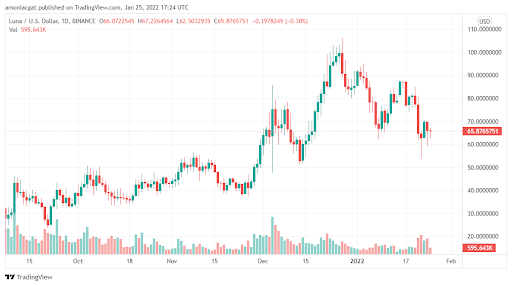
 In February 2019, LUNA was sold to the public for $0.8. Three years later, today, it is worth $69.13 with a market cap of $27.8 billion. Over 380 million LUNA was minted at launch, and 10% was allocated to Terraform Labs, 26% was given to project backers, 4% for genesis liquidity, and 20% each for project contributors Terra Alliance, and price stability reserve. There is a max supply of 1 billion, and 403.4 million is in circulation right now.

 LUNA is used to maintain the stability of the stablecoins by absorbing volatility. It serves as a reward for validators and delegators. It is used to secure and run the network. Also, it can be staked and used as a governance token. LUNA serves utility functions as well.

 It is one of the top ten cryptocurrencies by market cap. It peaked at $103.34 in December 2021.

Ending Note

 Due to its less volatility, it is a worthy investment. Terra (LUNA) is currently very prominent in Asia, but as it expands to other regions, the need for LUNA will also increase. Although LUNA is not a stablecoin, its job in the ecosystem would impact its price dynamic in the long run.

 As appealing as Terra is, don’t dive in without proper research. It would be nice to know this helped make the big decision, but it shouldn’t be the only thing you consult. Don’t forget to deal wisely, the crypto market is extremely risky.

The post 5 Reasons why you should buy Terra appeared first on Coin Journal.

5 Reasons why you should buy NEAR

 The volatility of the crypto space has made gaining wealth in the 21st century easy. All you need to simply do is invest at a low and take your profit at a high, but we both know it can’t be this easy. Regardless, you are already searching for a coin you can buy out of the over 10,000 cryptocurrencies in the market and go ahead to plan your retirement. Fortunately, you’ve been able to arrive at a list.

However, take your mind away from those coins on your list. Let me interest you in NEAR Protocol. So, consider these five reasons before you take the giant step. Before that, let’s cover the basics of Near Protocol.

 NEAR Protocol is a third-generation blockchain launched in 2017 by Alexander Skidanov and Illia Polosukhin. It was initially a machine learning platform. Now, it is a network that rewards computers for operating the platform. It was created to speed up transaction rates, increase throughput, and aid compatibility.

 It is a base layer on which decentralized applications can be created. Compared to other blockchains, it is sustainable, interoperable, secure, cost-effective, friendly, and pragmatic for users. The NEAR Protocol aims to revolutionize systems and impact how users use the web generally.

1. NEAR Protocol is accessible and usable

 NEAR Protocol is a community-run decentralised platform that supports the development and operation of dApps. It is a decentralised database and a computation platform without a server. It has made it easy for engineers and innovators to use it to create various products while also serving a pool of users. It is expanding the reach of Open Finance and paving the way for web 3.0.

 NEAR Protocol will allow the creation of user-friendly applications that would require little or no permission to be engaged. NEAR is based on a usability-first approach. This means that apps created on the network would mirror those on web platforms while also ensuring security. It would be simple to onboard projects and easy to subscribe, with predictable pricing and usage styles that users are familiar with.

 In essence, both users and developers will experience seamlessness on the platform. It would be easier to create accounts with domain names that can be comprehended by everyone. It has eliminated the need for Ethereum Name Service.

 For developers, creating and deploying applications have been simplified. They can use JavaScript, Rust, and AssemblyScript software development kits. They would also have the platform’s search tool, NEAR Explorer.

2. NEAR Protocol uses shards its Data

 NEAR Protocol employs a sharding approach which allows it to partition its data. This improves its scalability, making it run more transactions. This approach is called Nightshade. It allows the network to grow as the number of nodes increases.

 Sharding allows each node to store a small subset of the platform’s data. It splits the computing work across the nodes due to high network usage. These nodes handle the data processing and add the resulting information to the main chain. This improves the security of the network as the potential points of failure are reduced because each node oversees a part of the network.

 Also, it would help solve the blockchain trilemma. Asides from sharding, it has developed a dynamic re-sharding. This adjusts the number of shards regularly and dynamically based on the demands of users. This increases transaction throughput and reduces transaction costs.

 Unlike other blockchains that use this approach, all shards are a part of the main chain. It also has Doomslug. This enables validators to generate blocks in turn, once per epoch based on their stake. Block creation takes approximately one second.

3. NEAR Protocol uses an eco-friendly consensus algorithm

 Unlike the pioneer blockchains, NEAR Protocol uses a specialised proof-of-stake algorithm- Thresholded Proof-of-Stake. This makes it more decentralised by enabling the permissionless interaction of node operators with the network. It eliminates the pooling power of validators and allows the ubiquitous participation of node operators. It ensures a fair and predictable consensus.

 This promotes growth as more nodes would be able to join. It also allows developers and innovators to make money from their projects. It assigns a fee to a contract when it is created, and the developer can withdraw it.

 Unlike other proof-of-stake, delegated tokens are not lost when the validator is slashed for malicious behaviour; only the reward is lost.

4. NEAR Protocol has bridges

 Blockchains improve their interoperability by creating links with other blockchains. NEAR Protocol has several bridges to serve this purpose. It has become compatible with Ethereum Virtual Machine through the Aurora bridge. This makes it easier for developers to transfer their apps to the fast, low-cost, and scalable NEAR.

 It has also partnered with Terra to bridge Terra’s assets with the platform. Also, it has the Rainbow bridge that supports the transfer of funds between NEAR and Ethereum. Additionally, there is the Octopus Network, a network that allows interoperability with blockchains like Bitcoin, Polkadot, Cosmos, and so on. This would make it compatible with NEAR-based tokens and the Inter-Blockchain Communication protocol.

 These bridges increased their transaction throughput (721,061) in January 2022.

5. NEAR Protocol has an expanding ecosystem

 Due to its futuristic features and developers‘ community, it has witnessed an exponential growth of its ecosystem in the last two months. It is ranked the third fastest growing platform for developers right now. It plans to combine the creativity of its community with accurate decisions and execution. Also, it hopes to aid a fast improvement of its protocol with the supervision and input of the community.

 It aims to provide the platform for the birthing of web 3.0. Flux protocol, Mintbase, and Paras are some of the popular projects on the ecosystem.

Ending Note

 To invest in NEAR Protocol would be to buy its native token, NEAR. NEAR is used as a reward for node operators and validators. It is used to pay for transactions, run applications, and reserve storage units for applications. It is also burnt as a deflationary measure. To get more NEAR, you can stake, participate in bounties, win a NEAR hackathon, run a community, create on the network, or be an active community member.

 As of today, NEAR is ranked 22, with a market cap of $8.5 billion. It costs $13.77 right now and peaked at $20.44 in January 2022. Out of the 1 billion total supply, 618.4 million is in circulation right now. It is trading on Binance, MEXC Global, and Huobi Global right now.

 If you can already picture the web 3.0 world, then you won’t hesitate to bag some NEAR. However, the decision is yours to make; in the end, it would be your loss or gain. As always, this is not financial advice. Do your research and deal wisely.

The post 5 Reasons why you should buy NEAR appeared first on Coin Journal.