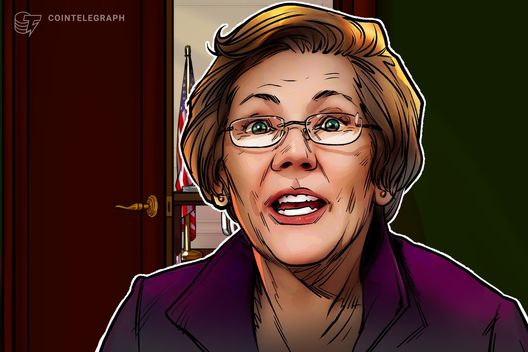
Die ranghohe Senatorin Elizabeth Warren kritisiert eine etwaige Rettung der Kryptobranche durch die Regierung von Donald Trump.

Finanzmittel Info + Krypto + Geld + Gold
Krypto minen, NFT minten, Gold schürfen und Geld drucken
Die ranghohe Senatorin Elizabeth Warren kritisiert eine etwaige Rettung der Kryptobranche durch die Regierung von Donald Trump.
Uniswap’s native token, UNI, has seen its price dip despite the ongoing governance push to expand protocol fees across more chains and all v3 pools.
While the protocol fee expansion promises to increase token burns and revenue for the protocol, short-term price action has remained under pressure.
The dip comes amid a broader downturn in the cryptocurrency market, with traders closely watching key support and resistance levels.
The Uniswap community is currently voting on a proposal to activate protocol fees across all remaining v3 pools on Ethereum mainnet.
In addition, the plan includes extending fees to eight other networks, including Arbitrum, Base, Celo, Optimism Mainnet, Soneium, X Layer, Worldchain, and Zora.
This proposal is notable because it is the first to use the updated governance process known as UNIfication.
This system allows fee parameter changes to bypass the traditional proposal stage, speeding up voting while retaining on-chain security.
If approved, fees collected on these chains would flow to chain-specific TokenJar contracts before being bridged back to the Ethereum mainnet.
From there, UNI tokens would be burned, effectively reducing supply and increasing scarcity over time.
The proposal also introduces a new tier-based system for v3 pools, known as v3OpenFeeAdapter.
Instead of setting fees pool by pool, the system applies fees based on liquidity provider fee tiers.
This simplifies governance oversight and ensures every pool automatically contributes to protocol fee revenue.
Despite these ambitious plans, UNI’s market performance has struggled.
The token opened today at $3.56 but quickly fell, losing 4.8% from its opening price.
UNI briefly rallied to $3.59 but faced resistance and could not sustain momentum.
This highlights that market sentiment is cautious, even as governance improvements promise long-term benefits.
Currently, UNI is trading around $3.40, down roughly 4.7% in the last 24 hours.
Its market cap sits at just over $2.15 billion, while total value locked in Uniswap remains above $3 billion.
While the protocol fee expansion may boost long-term value and increase token burns, market reaction shows that short-term price action is likely to remain volatile.
The support at $3.38 is critical, according to market analysis.
If the token holds above this level, it may attempt to move toward the first major resistance at $4.24.
If the token breaches $4.24, it could open the path to $4.76, with a third resistance at $5.41.
However, failure to maintain above the support at $3.38 could see UNI struggle in the short term, limiting the impact of positive governance developments.
The post UNI price falls further despite Uniswap Protocol fee expansion proposal appeared first on CoinJournal.
After the recent surge from around $0.24, Cardano (ADA) has struggled around the $0.27–$0.28 range for several weeks now.
However, recent developments and chart patterns signal a possible breakout.
One of the main factors driving renewed interest is the announcement that Coinbase now allows ADA to be used as collateral for loans.
This new feature allows users to borrow up to $100,000 in stablecoins without selling their ADA holdings.
Investors who want liquidity but wish to retain their ADA can now do so, thereby avoiding potential taxable events associated with selling.
This feature is especially appealing in volatile markets where traders want flexibility without exposing themselves to full downside risk.
It also underscores ADA’s growing real-world utility. Holding ADA is no longer just a speculative play; it can now serve as a financial instrument.
Large holders, often referred to as whales, may be particularly motivated by this.
Using ADA as collateral encourages them to maintain or even increase their positions.
This kind of activity often reduces supply pressure and stabilises the token in periods of uncertainty.
Moreover, as more users access these loans, the network effect could drive broader adoption across crypto platforms.
It positions ADA as a more functional and versatile asset, strengthening its market presence.
At the same time, ADA’s charts are showing promising signs that a reversal may be in play.
Trading volume has sharply declined over recent months, reaching a multi-month low.
While falling volume often indicates waning interest, in this case, technical indicators suggest something more nuanced.
An inverse head-and-shoulders pattern has started to form, which is typically a bullish signal.
The Relative Strength Index (RSI) also shows divergence, suggesting that the selling pressure is easing and buyers may be stepping in.

If ADA can push above the $0.30 resistance level, it could ignite a rally toward $0.40 or even higher.
Support around $0.27 is now critical; a drop below this level could erode bullish momentum and delay any breakout.
A further slide below $0.22 would indicate that the reversal pattern has failed, potentially opening the door to extended losses.
Even with short-term uncertainty, the combination of technical patterns and Coinbase integration is creating cautious optimism among traders.
Whales are also accumulating the altcoins.
On-chain data from Santiment shows that large holders have been steadily increasing their ADA positions, often a sign that strong hands are preparing for a sustained move higher.
Historically, such accumulation tends to precede upward price momentum once market conditions improve.
The alignment of technical signals, increased utility, and investor confidence could make the coming weeks critical for ADA’s trajectory.
For traders and holders, these developments suggest that Cardano may be on the verge of breaking out from its current consolidation phase.
The post Cardano (ADA) flashes technical reversal signals following Coinbase integration appeared first on CoinJournal.
Solana has entered a fragile phase as selling pressure builds and confidence across the market continues to fade.
The token has slipped below the $82 area, a level that previously acted as a short-term cushion for price action.
The futures market has played a major role in amplifying Solana’s downside move.
Liquidations have increased, and long positions have been forced out as price drifts lower, creating bursts of sharp selling during the intraday declines.
Open interest across derivatives markets has also been falling, pointing to traders closing positions and stepping aside rather than betting on a fast rebound.
Funding rate has also turned negative, showing a growing dominance from short sellers who are willing to pay to maintain bearish exposure.

While leverage flushes can sometimes reset the market, there is little evidence of that shift yet.
Instead, each liquidation wave has been followed by muted buying interest.
Beyond price and derivatives, Solana is also facing softer signals from on-chain activity.
Transaction-driven revenue has declined from recent peaks, suggesting lower demand for block space and reduced speculative activity.
A good percentage of the network usage is currently tied to short-lived trends rather than sustained growth.
That reliance leaves the network activity vulnerable as market sentiment cools.
Investor confidence has also softened as the price struggles to reclaim key resistance zones.
Repeated failures near higher levels have reinforced a wait-and-see attitude.
Even though new wallets continue to appear, overall engagement lacks momentum, especially as the hype around memecoins, which form the bulk of Solana’s engagement, fades.
This imbalance highlights the difference between long-term interest and short-term participation.
The result is a market caught between underlying potential and immediate pressure.
Traders should closely watch the $80 level as the first major line of defence in case of a further decline.
A clean break below this zone could expose the price to deeper losses.
If selling continues, the next area of interest sits between $75 and $76, which has previously acted as a stabilisation zone during corrections.
Failure there would open the door toward the low $70s, which would result in even more liquidations.
On the upside, analysts note that Solana needs to reclaim the $85-87 range to ease immediate pressure.
If SOL moves above $87, bulls will be in control, and the next target sits around $90.
A move beyond that level would be required to shift sentiment meaningfully.
The post Solana weakens as liquidations rise and sentiment cools appeared first on CoinJournal.
XRP cryptocurrency has held steady above $1.40, showing resilience despite a broadly cautious market.
Recent developments in US policy have added a fresh layer of optimism for XRP enthusiasts.
Arizona lawmakers are moving forward with legislation that could formally include XRP in a state-managed digital assets fund.
The proposal seeks to create a strategic reserve for digital currencies obtained through seizures or confiscations.
XRP, alongside Bitcoin (BTC), is explicitly listed as an eligible asset.
🚨BREAKING: ARIZONA ADVANCES BILL TO ADD XRP TO OFFICIAL STATE DIGITAL ASSET RESERVE 🇺🇸🔥
Arizona’s Digital Assets Strategic Reserve Fund bill (SB1649) just CLEARED the Senate Finance Committee in a 4–2 vote — and it explicitly includes $XRP in the RESERVE. 👀
The bill now… pic.twitter.com/2x8uVH6LXD
— Diana (@InvestWithD) February 17, 2026
The bill recently passed a key Senate committee in a 4-2 vote, marking a significant step forward.
If enacted, the fund would be managed by the state treasurer with strict custodial oversight.
This move would make Arizona one of the first US states to formally reference XRP in a government financial framework.
For XRP holders, this development is largely symbolic.
The state would not be directly purchasing XRP with taxpayer money, but inclusion in the reserve adds credibility.
It reinforces XRP’s reputation as a functional and settlement-oriented digital asset rather than just a speculative token.
XRP’s short-term price action has been mixed.
The coin is supported around $1.40 to $1.44, creating a key floor that traders are watching closely.
Exchange outflows suggest accumulation by larger holders, while smaller whales have added to their balances, hinting at potential upward pressure.
Technical indicators show both bullish and bearish signals.
Momentum oscillators suggest limited buying activity in the short term, but longer-term smart money metrics point to possible gains.
Patterns on the charts indicate that a break below $1.42 could trigger a short-term pullback toward $1.12.
At the same time, if support holds, traders could see upside targets near $1.91 and $2.13.
XRP has been rangebound for the past month, but the combination of policy developments and structural market accumulation could push it higher.
Policy developments in Arizona, combined with accumulation patterns and technical support, may give XRP the momentum it needs to challenge its next resistance levels.
Traders should watch the $1.40–$1.44 support zone closely.
A strong hold here could set the stage for a breakout.
The resistance levels to monitor are $1.50 and $1.54 in the near term.
Beyond that, the next targets are $1.67 and $1.91.
These levels align with smart money accumulation and historical trading ranges.
A sustained move above $2.00 could signal a return of broader bullish sentiment.
Overall, XRP’s price is poised in a delicate balance.
Short-term caution is warranted, but medium-term prospects look promising.
The post XRP gains momentum as Arizona moves to add it to state crypto reserve appeared first on CoinJournal.