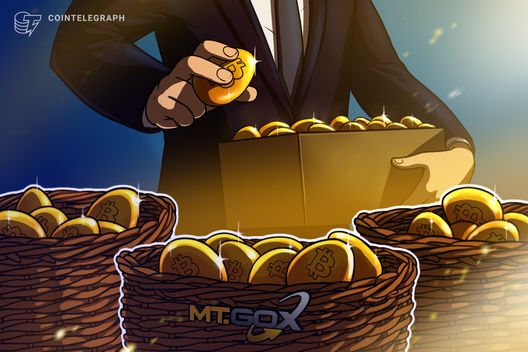
Die inzwischen aufgelöste Kryptowährungsbörse Mt. Gox hat einige lang erwartete Rückzahlungen an Kunden um ein weiteres Jahr bis zum 31. Oktober 2026 verschoben. Grund dafür seien unvollständige Gläubigerverfahren.

Finanzmittel Info + Krypto + Geld + Gold
Krypto minen, NFT minten, Gold schürfen und Geld drucken
Die inzwischen aufgelöste Kryptowährungsbörse Mt. Gox hat einige lang erwartete Rückzahlungen an Kunden um ein weiteres Jahr bis zum 31. Oktober 2026 verschoben. Grund dafür seien unvollständige Gläubigerverfahren.
Citigroup Inc. and Coinbase Global Inc. are partnering to enhance digital-asset payment solutions for the bank’s corporate clients, marking another major step by a traditional financial institution toward embracing blockchain technology.
The collaboration reflects Wall Street’s growing interest in digital assets after years of regulatory caution and market volatility.
The initiative aims to make it easier for Citi’s institutional clients to move funds between cryptocurrencies and traditional fiat currencies — a long-standing challenge in the digital economy.
The move comes as banks and payment providers increasingly explore blockchain to enable faster, cheaper, and more efficient transactions across global financial networks.
The initial phase of the Citi-Coinbase partnership will focus on simplifying the process of converting crypto to fiat and vice versa, particularly for cross-border transactions.
Debopama Sen, head of payments for Citi Services, said the bank’s clients are increasingly seeking innovations that go beyond traditional transaction models.
Citi’s clients want “programmability and conditional payments and other cost and speed and efficiency aspects,” Sen said, emphasizing the growing demand for payment systems that can operate continuously and offer greater flexibility than conventional financial rails.
Sen added that Citi is also “exploring solutions to really enable on-chain stablecoin payments for our clients” in the coming months, noting that stablecoins could play a key role in the evolution of corporate payment infrastructure.
“Stablecoins will be another enabler in the digital payment ecosystem,” she said.
“It’ll help grow the space, it’ll help grow functionality for our clients.”
Stablecoins — cryptocurrencies typically pegged to fiat currencies such as the US dollar — have become one of the most promising use cases for blockchain technology.
They combine the efficiency of digital payments with the relative stability of traditional money, making them increasingly attractive for corporate transactions and settlements.
Citi’s “Future of Finance” team, led by Ronit Ghose, has projected that the global stablecoin market could surpass $1 trillion within five years, up from about $300 billion today.
This growth outlook underscores how blockchain-based assets are rapidly evolving from speculative investments to tools for practical financial operations.
The collaboration with Coinbase follows Citi’s earlier introduction of a blockchain platform that enables institutional clients to move tokenized deposits around the clock within the bank’s internal network.
This system offers clients real-time settlement capabilities, reducing the delays and costs associated with traditional payment systems such as ACH and wire transfers.
Coinbase, one of the world’s leading digital-asset exchanges, brings extensive infrastructure and experience to the partnership.
The company works with more than 250 banks and financial institutions globally, according to Brian Foster, Coinbase’s global head of crypto-as-a-service.
“Coinbase has spent years developing very specialized infrastructure,” Foster told Bloomberg News, adding that traditional financial institutions are increasingly seeking partnerships across various crypto-related services — from spot and derivatives trading to custody, staking, and payments.
Foster said that growing interest in stablecoins, crypto exchange-traded funds (ETFs), and tokenized assets is prompting more financial institutions to engage with blockchain-based systems.
As Citigroup and Coinbase explore new ways to bridge traditional banking and digital assets, their collaboration signals how mainstream finance is steadily integrating blockchain into its infrastructure — moving beyond experimentation toward real-world adoption.
The post Citigroup and Coinbase partner to expand digital-asset payment capabilities appeared first on CoinJournal.
Reliance Global Group Inc. (NASDAQ: RELI) has expanded its cryptocurrency portfolio with the addition of Solana (SOL), marking another step in its ongoing digital asset treasury strategy.
The move positions the company among a growing list of publicly traded firms integrating blockchain-based assets into their corporate balance sheets.
The announcement, made on October 27, 2025, confirms that Reliance now holds five of the top ten cryptocurrencies by market capitalization — Bitcoin, Ethereum, Cardano, XRP, and Solana.
The addition underscores the company’s belief in the long-term potential of blockchain technology and its applications in both finance and enterprise innovation.
Reliance’s decision to purchase Solana represents a milestone in its broader digital asset diversification strategy.
The company described the acquisition as part of its disciplined approach to building exposure across major blockchain ecosystems.
“By adding Solana alongside Bitcoin, Ethereum, Cardano, and XRP, we continue to execute our disciplined strategy of diversifying across leading blockchain ecosystems,” said Moshe Fishman, a member of the Reliance Global Group Crypto Advisory Board and Director of Insurtech at Reliance. “Solana represents the next generation of blockchain performance — built for real-world adoption and institutional-scale applications.”
Solana, currently the sixth-largest cryptocurrency by market capitalization at over $110 billion, has become increasingly attractive to corporate treasuries and institutional investors.
Known for its hybrid Proof-of-Stake and Proof-of-History consensus mechanisms, Solana can process over 65,000 transactions per second, with blocks confirming in about 400 milliseconds.
The blockchain’s scalability and efficiency have made it a favored platform for decentralized finance (DeFi), non-fungible tokens (NFTs), and Web3 applications.
Fishman noted that expanding into Solana aligns with Reliance’s commitment to innovation while maintaining a balanced approach to governance, security, and compliance.
Solana’s inclusion in Reliance’s treasury comes amid growing institutional and corporate interest in the blockchain.
Its expanding ecosystem — spanning DeFi protocols, tokenized real-world assets, and NFT platforms — continues to drive adoption.
Market analysts point to the increasing appeal of Solana as a potential treasury asset, bolstered by the anticipation of regulatory approval for spot Solana exchange-traded funds (ETFs).
The token traded near $200 on October 27, reflecting broader optimism surrounding blockchain utility and scalability.
Reliance’s move follows similar announcements by other public companies in recent months, as corporate treasuries diversify away from traditional assets to hedge against inflation and capture long-term value in digital markets.
The addition of Solana to Reliance Global Group’s treasury is a strategic effort that many other public companies have tapped into across the market.
SOL’s price has largely benefited from the sentiment around these efforts.
While DeFi, NFTs and RWA traction stands out, Solana’s native token has received notable upside momentum from the growing treasury asset plays.
Forward Industries, Solana Company, Upexi, DeFi Development Corp, Sol Strategies and Sharps Technology are among the top SOL treasury companies.
Data from CoinGecko shows the 10 leading public companies cumulatively hold over 15.7 million SOL, currently worth over $3.18 billion.
The post Solana boost as Reliance adds SOL to treasury holdings appeared first on CoinJournal.
The Hyperliquid price has seen a brief pullback after a significant surge today, shedding 1.2% to trade around $46.57.
Despite this short-term dip, the HYPE token remains up 19.5% over the past week, highlighting continued investor interest and optimism about the project’s long-term prospects.
The retracement follows a strong rally and reflects a blend of profit-taking, technical rejection, and growing competition in the decentralised derivatives space.
After a robust run last week, Hyperliquid encountered selling pressure near the 38.2% Fibonacci retracement level at $49.36.
The failed breakout prompted traders to lock in gains, leading to a brief correction.
The MACD histogram is flipping negative on the 4-hour chart, signalling weakening short-term momentum, while the RSI eased from overbought territory at 69.89, suggesting that the market needed a cooldown after a 19% weekly surge.

Part of the sell-off also reflects the growing rivalry between Hyperliquid and the newly launched Binance-backed Aster DEX.
Since its debut on September 17, Aster has attracted massive trading volumes, processing $20.8 billion on its first day compared to Hyperliquid’s $9.7 billion.
Aster’s rapid adoption and $2 billion in total value locked within a week have shifted liquidity across the decentralised perpetuals landscape, briefly denting Hyperliquid’s dominance.
Still, Hyperliquid maintains a commanding presence in the market.
With a $12.74 billion market cap and a total value locked (TVL) of $4.85 billion, it remains one of the largest decentralised derivatives platforms.
However, traders are watching closely as the project faces near-term headwinds from both external competition and internal supply pressures.
The most immediate challenge facing HYPE is a looming token unlock event beginning on November 29.
Around 237.8 million tokens — roughly 24% of the total supply — will begin to unlock over 24 months.
At the current price, this adds nearly $500 million per month in potential sell pressure, partially offset by $65 million in monthly buybacks from the project’s treasury.
This could lead to a monthly imbalance of around $410 million, which could lead to near-term volatility as the market adjusts to the increased supply.
Despite these concerns, the project’s $1 billion treasury filing, connected to the Sonnet Bio and Rorschach merger, could help counterbalance some of the dilution fears.
The treasury’s size and strategic reserves give the team room to manage liquidity and maintain market confidence through buybacks or ecosystem growth initiatives.
While short-term traders may focus on resistance levels, derivatives, and on-chain data tell a more optimistic story.
Futures open interest (OI) on HYPE has surged from $1.27 billion last Wednesday to $1.97 billion on Monday, the highest level since early October.

Rising open interest signals new capital entering the market, typically an indicator of growing bullish conviction.
Data from CryptoQuant also shows that whales — large investors — are increasing their positions, with buy orders dominating both spot and futures markets.
This accumulation trend suggests that institutional and high-net-worth participants expect further gains ahead.
Network data reinforces this bullish sentiment.
According to Artemis Terminal, Hyperliquid’s 24-hour chain fee revenue reached $2 million, surpassing edgeX and BNB Chain.
High network fees often correlate with elevated trading activity and liquidity, signalling robust user engagement even amid short-term market uncertainty.
Technically, HYPE has shown resilience after breaking above its descending trendline and the 50-day exponential moving average (EMA) at $43.54.
Over the weekend, it held that level as support before climbing back above $48.57.
If the token closes above the next resistance at $51.15, analysts expect the rally to extend toward the record high of $59.46, last seen on September 18.
However, a failure to hold above the $43.54 EMA could open the door for a deeper correction toward the $41.6 support zone.
The post Hyperliquid price forecast after rejection at the 38.2% Fibonacci retracement level appeared first on CoinJournal.

JPYC-Präsident Noriyoshi Okabe sagte, dass der Stablecoin bereits das Interesse von sieben Unternehmen geweckt habe, die sie in ihre Dienstleistungen integrieren möchten.