UAE’s Ras Al Khaimah launches free zone for digital assets and Web3

  • Ras Al Khaimah, UAE, has introduced RAK DAO, a free zone dedicated to digital assets and Web3.
  • RAK DAO will offer entrepreneurs 100% ownership of their businesses and a unique regulatory framework.
  • The UAE continues to attract global crypto and Web3 firms through progressive regulatory measures.

Ras Al Khaimah, one of the seven Emirates of the United Arab Emirates (UAE), has unveiled its latest initiative to diversify its economy by launching the RAK Digital Assets Oasis (RAK DAO), a dedicated free zone for digital and virtual asset companies.

In a move to attract global crypto players, the emirate is positioning itself as a forward-thinking hub for emerging technologies.

A purpose-built free zone for digital assets

RAK DAO is poised to become the world’s first free zone solely dedicated to digital and virtual asset companies, creating a purpose-built ecosystem for entrepreneurs from around the globe.

This free zone is designed to support companies involved in cutting-edge technologies, including the metaverse, blockchain, utility tokens, virtual asset wallets, nonfungible tokens (NFTs), decentralized autonomous organizations (DAOs), decentralized applications (DApps), and other Web3-related businesses.

Entrepreneurs within the free zone will have 100% ownership of their businesses and enjoy unique tax schemes and regulatory frameworks. While RAK DAO is expected to begin with non-financial activities, it may introduce financial activities at a later stage, underlining the emirate’s commitment to innovation and regulatory compliance.

UAE’s attraction for crypto and Web3 firms

The UAE has been actively courting crypto and blockchain firms with a progressive regulatory environment.

Dubai introduced a virtual assets law and the Virtual Asset Regulatory Authority to safeguard investors and establish industry standards. Additionally, the Abu Dhabi Global Market (ADGM) and the Dubai International Financial Centre (DIFC) have their own financial regulators, offering attractive free zones for digital asset businesses. The Dubai Virtual Assets Regulatory Authority went ahead and even launched headquarters in The Sandbox in May 2022.

Several crypto firms have since secured operational licenses to operate in Dubai. Some of the companies that have acquired licenses to operate in Dubai include Binance, which was the first to acquire an MVP license in Dubai, Crypto.com, and OKX.

Ras Al Khaimah’s RAK DAO complements the more than 40 multidisciplinary free zones in the UAE, further positioning the country as a destination of choice for crypto, blockchain, and Web3 enterprises.

Applications for RAK DAO are open, offering entrepreneurs and digital asset companies a new opportunity to thrive in this burgeoning industry. This initiative signifies the UAE’s commitment to fostering innovation and embracing the future of finance and technology.

The post UAE’s Ras Al Khaimah launches free zone for digital assets and Web3 appeared first on CoinJournal.

FTX trial: FTX used billions in customer funds for Binance stake buyback

  • FTX is accused of using customer deposits to repurchase Binance stake.
  • An accounting professor hired by the US Department of Justice reveals over a billion dollars came from customer funds for the share buyback.
  • FTX’s proposed recovery plan offers hope, aiming for a 90% asset return to customers affected by the exchange’s bankruptcy.

In a shocking revelation, the ongoing legal proceedings surrounding the defunct cryptocurrency exchange FTX have unveiled that the exchange allegedly used customer funds to buy back its stake held by Binance.

This development has raised serious concerns about the handling of customer deposits within the crypto industry.

Customer funds diverted for Binance share repurchase

During a court hearing, it was disclosed that FTX, a crypto exchange that filed for bankruptcy in November 2022, employed customer deposits to repurchase its shares from competitor Binance. Binance CEO Changpeng Zhao in November 2022 acknowledged that his company had received over $2.1 billion in Binance USD (BUSD) stablecoins and FTX’s FTT tokens as part of this transaction.

The revelation has led to intense scrutiny and legal action, with an accounting professor from the University of Notre Dame, Peter Easton, being hired by the US Department of Justice to trace the flow of billions of dollars between Alameda, the parent company of FTX, and the exchange. Professor Easton confirmed that user deposits were redirected for various purposes, including reinvestment in businesses and real estate, political contributions, and charitable donations.

The most significant revelation, however, was that over a billion dollars for the share repurchase had come directly from customer funds held by FTX. This has raised concerns about the exchange’s financial practices and the protection of customer assets.

FTX’s recovery plan

Amidst the controversy surrounding the use of customer funds, FTX’s estate has proposed a settlement plan to address the loss of customer assets when the exchange declared bankruptcy in November 2022. The plan aims to provide a 90% return of assets to affected customers, potentially offering relief to those who suffered losses during the exchange’s collapse.

This development signifies a potential path forward for affected customers and highlights the ongoing efforts to resolve the fallout from FTX’s bankruptcy. The legal and regulatory proceedings will be pivotal in determining the fate of this proposed recovery plan and the ultimate distribution of customer assets.

The post FTX trial: FTX used billions in customer funds for Binance stake buyback appeared first on CoinJournal.

Ripple drops another 2% today: a descending triangle points to more downside

  • Ripple’s bearish momentum continues
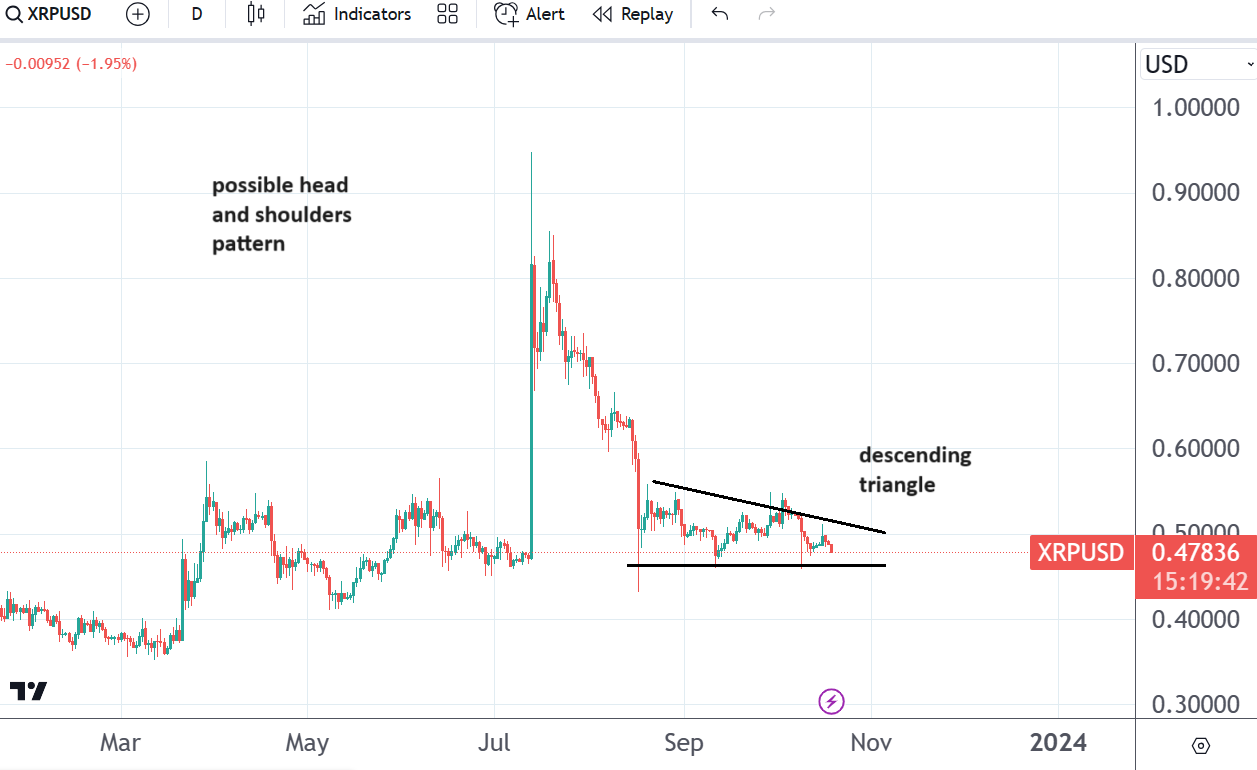
  • A descending triangle points to a drop to $0.4
  • A head and shoulders pattern paints a gloomy picture for Ripple

There is no break from the bearish momentum in the cryptocurrency market. Unless you are invested in Bitcoin, the suffering from being on the long side of any other coin has been tremendous. 

Take Ripple (XRP/USD), for example. 

After spiking close to $1 during the summer, it quickly returned all its gains. Basically, a classic pump-and-dump price action, enough to attract late newcomers to the party, only to see their investment quickly disappear. 

More problematic is the recent price action. It gives no signs of the bearish pressure easing anytime soon. 

Just the opposite, as the market appears to form a bearish continuation pattern – a descending triangle. 

Ripple chart by TradingView

Descending triangle points to a quick move to $0.5

As a bearish continuation pattern, a descending triangle hints at more downside to come. Its measured move equals the length of the longest segment of the triangle – in this case, it signals a drop to $0.4. 

The main feature of such a triangle is the fact that bounces from horizontal support are smaller and smaller until, eventually, support gives way. 

On an even bigger scale, the descending triangle might just be the right shoulder of a head and shoulders pattern. If that is the case, the spike during the summer months close to the $1 area would be the head of the pattern. 

If a head and shoulders pattern does materialize, Ripple has much more room to the downside than bullish investors would want to assume now. 

The post Ripple drops another 2% today: a descending triangle points to more downside appeared first on CoinJournal.