Vitalik Buterin revisits his early crypto predictions, admits he ‘missed’ NFTs

  • Ethereum co-founder revisited the topic of Bitcoin regulation and Ethereum’s transition to proof-of-stake consensus mechanism.

  • Buterin also talked about altcoins, decentralised finance (DeFi), and non-fungible tokens (NFTs).

Ethereum co-founder Vitalik Buterin has shared some of his biggest predictions in the crypto space over the past decade, admitting in a Twitter thread that he got a few completely wrong.

He also reflected on the lessons learned, explaining where he stands today about subjects such as Bitcoin regulation, stablecoins, the Ethereum proof-of-stake roadmap, and Bitcoin Cash.

On Bitcoin and the regulatory climate

One of Buterin’s earliest comments about crypto regulation is from July 2013, when the Ethereum co-creator talked about increased regulatory attention on Bitcoin and the consequences these would have on the pioneer crypto.

But while he felt Bitcoin was resistant to government interference, he felt growing regulation of Bitcoin services such as exchanges was impactful.

Bitcoin is resisting the government not by being clever about what ‘legal category’ it’s in, but rather by being technologically censorship-proof,” he summed up his belief in those early days.

As per what he thinks today, Buterin shared that he believes decentralization sits well with Bitcoin and would be the reason it survives even in the harshest of regulatory environments. However, he still thinks just being censorship-resistant isn’t enough if the flagship cryptocurrency were to flourish.

Sure, Bitcoin’s decentralization would let it still “survive” under a super-hostile regulatory climate, but it could not “thrive,” he noted.

According to him, for a censorship resistance strategy to succeed, the network needs to have both “technological robustness and public legitimacy.” Without these, he opines, chances of thriving are limited.

Ethereum’s PoS and sharding roadmap

On this one, the Ethereum co-founder said it was almost laughable what he put forth as the timeline for the switch from proof of work to proof of stake.

Among the mistakes, he noted, was that he “deeply underestimated the complexity of software development.

On proof of work vs. proof of stake, Buterin feels his earlier outlook on PoW’s energy waste was “apologist.” But now that he’s had an “intellectual evolution” on the topic, what’s good in PoW and PoS.

On Bitcoin Cash, DeFi and NFTs

While he was very positive about altcoins early on, his outlook on some projects has completely changed.

He points out Bitcoin Cash as one of the projects he thinks have failed, with the core reasoning being that its proponents largely coalesced around a rebellion and not competence and coherence.

Among other predictions in the Ethereum whitepaper were ERC20-style tokens, DAOs, Oracles, algorithmic stablecoins, and Domain Name Systems (like ENS).

Buterin’s take is that he got most right, including his idea on Uniswap and basically predicting DeFi. However, he admits to failing to predict NFTs.

The post Vitalik Buterin revisits his early crypto predictions, admits he ‘missed’ NFTs appeared first on Coin Journal.

5 Reasons to buy Solana over Ethereum

While both cryptocurrencies have nice worths, their values go beyond being cryptocurrencies to their underlying blockchains. Solana (SOL) and Ethereum (ETH) power and serve as the native coins of two giant blockchains. Although they have great similarities, they have distinct differences. As a first mover, the Ethereum blockchain experienced massive growth for its responsibility for decentralised applications. Similar to this was its involvement in creating digital assets (NFTs). However, this has created worthy competitions, one of these being the Solana blockchain. And while the founders of Solana believe there can be some form of a beneficial relationship, crypto enthusiasts believe it’s the „Ethereum killer.“

 Solana was created two years after Ethereum by Anatoly Yakovenko to resolve the problem of scalability existing among the blockchains of that time. It sought to overcome the resistance faced with censorship also. The Solana blockchain is a third-generation distributed ledger that promises efficiency using fewer nodes. Its whitepaper and testnet were released in 2018, while a beta of the mainnet was launched in March 2020. The blockchain, unlike the ones before it, was built on eight key technologies, including a proof-of-history mechanism, a Tower BFT, a block propagation protocol (Turbine), a unit for transaction validation optimization (Pipelining), a storage unit for its ledgers (Archivers), a processing unit for smart contract transactions (Sealevel), and a protocol that shares data across the network (Cloudbreak). The technologies served as the basis of the innovation known as the Solana blockchain today. However, this alone cannot convince you to choose it over Ethereum; so, consider the following.

Consensus mechanism

Unlike Ethereum, the Solana blockchain uses Tower Byzantine Fault Tolerance (BFT) (a modified PBFT) to secure its operations. It is incorporated with a delegated proof-of-stake (DPoS) that employs a voting and reputation system in securing and running the network. Asides from this, it uses the proof-of-history novel approach. This allows the network to add time to its ledgers, thereby verifying transaction time. It also links messages from nodes together, allowing chronological validation of blocks. This implies that the consensus process becomes faster, and transaction latency and messaging overhead are reduced. Similarly, each node can independently verify the validity of transactions.

Room for growth

The blockchain still has excess growing potential giving that it can also interact with smart contracts. It currently houses several projects cutting across dApps, DEXs, DeFi platforms, and automated market makers (AMMs). The Solana ecosystem boasts of numerous wallets, oracles, stablecoins, and infrastructures. It entered into the NFT space with the launch of the Degenerate Ape Academy. This contributed to its native token experiencing over a 10,000% increase in price. It has over 400 dApps projects on its network. Notable examples are Serum, Audius, Raydium, Open Ocean, DeFi Land, Metaplex, and Francium. Its coin is currently trading at $174.35, which is over $3500 less than Ethereum. Solana is still growing- project-wise and value-wise. Investing in it at this point would be ideal.

Scalability and speed

The blockchain also solves one of the blockchain trilemmas. It has gained massive traction and adoption due to its scalability and speed. Unlike Ethereum, it is fast and scalable. While Ethereum still struggles with 15 to 45 transactions per second (TPS), Solana is already doing 50,000 TPS and can do more. In context, it is 4000x faster than Ethereum. This throughput also gives it an edge with transaction cost; the more transactions you can run, the lesser the cost to run them. So, it charges lesser than Ethereum for its transactions- around $0.00025 per transaction. The diverse technologies behind the blockchain can maintain its speed and efficiency without a layer-2 blockchain. It can maintain its target throughput and speed as more projects are set up in the ecosystem. Its low processing power and proof-of-history model is built to be efficient and secure. Due to the high fees and congestion of the Ethereum blockchain, it is the best alternative.

Environmental impact

The question about how friendly cryptocurrencies are to the environment has hampered their mass adoption. Everyone is advocating for eco-friendly projects. Bitcoin and Ethereum use a mining model (proof-of-work) that adversely affects the environment. However, Solana is set to be energy efficient with its novel consensus mechanisms. This is because its mining model requires little computing power. Validators use their native coin (SOL) in providing computational services and operating the network. Solana has also developed a bridge that allows the transfer of assets from Ethereum to Solana; this would help reduce the use of Ethereum, thereby reducing its environmental impact. By far, Solana is a greener alternative to preceding blockchains.

SOL

This is the native token of the Solana blockchain and has several use-cases. It can be delegated to a validator or staked for rewards. It can also be used to make payments, settle transaction fees, access the projects on the blockchain, and as a governance token. Out of the SOL initially minted, 60.4% is under the care of the founders, Solana Foundation, and locked investors. 1.6% was sold at auction, and 38% was allocated to the community. Of the 508.2 million total supply, 309.3 million is in active circulation. It is currently ranked 5th with a market cap of $53.9b. SOL gives an annual percentage yield of over 5% when staked.

 Solana has the third-largest futures market and is tops in TVL, users, and derivatives market. Also, it has very attractive features. However, it should be noted that the Ethereum blockchain has more decentralised applications and more stability. This is negated by the Solana blockchain’s speed, scalability, and transaction cost. As investors, developers, and crypto enthusiasts are looking for an alternative to Ethereum; they look to Solana as it offers virtually everything the Ethereum blockchain offers and more at less cost and high speed. There is a wide gap between the prices of ETH and SOL, but it would be smarter to buy 15 SOL than 1 ETH. However, anything you decide to do, be smart, do your research, and do the dollar-cost averaging. Remember that the crypto space is highly risky and volatile, so only invest the capital that you can let go peradventure you hit loss; invest wisely.

The post 5 Reasons to buy Solana over Ethereum appeared first on Coin Journal.

Brian Kelly on 3 “under-the-radar” metaverse tokens to watch in 2022

The investor says Axie Infinity, The Sandbox, and Decentraland could explode again amid network growth and the metaverse hype.

“Fast Money” trader Brian Kelly has highlighted three coins he says he’s been tracking and which he believes have the potential to see greater adoption and price increase long term.

According to the crypto investor, the three “under the radar” projects are all metaverse-linked – in the gaming or virtual world sectors. He told CNBC’s post-market show that these are tokens he’s been watching and which he believes are set to outperform as the underlying networks mature.

He also highlighted that as the metaverse idea takes solid shape, a lot of interest is likely to be around Ethereum and Solana, blockchain networks that could see significant activity related to the metaverse. The investor also sees opportunities in layer 2 protocols or decentralised applications (Dapps).

Kelly says his top picks for trading opportunities are play-to-earn (P2E) token Axie Infinity (AXS), metaverse and NFT linked The Sandbox (SAND), and Ethereum-powered decentralised virtual reality token Decentraland (MANA).

He believes these tokens’ value will keep increasing as the space grows, noting that it’s all about the network effect. He noted:

“Just as Facebook [Meta] grew, the price of its stock grew and as these networks grow – these virtual worlds grow – the value of the underlying currency needs to grow to service that underlying economy.”

Axie Infinity (AXS)

On Axie Infinity he says that the gaming token’s explosive growth this year has more and more people looking to play, and as the network grows, so does the value of the underlying token AXS. The token’s price is up 16,819% this year, with its value against the US dollar around $95.48 (as of writing) according to data from CoinGecko.

The Sandbox (SAND)

The Sandbox (SAND), also Kelly’s top pick among tokens trading “under the radar” currently trades around $5.89 and has soared 15,561% this past year. The Sandbox is a Roblox-like decentralised virtual world that allows for gaming and trading of tokens, with participants taking true ownership of assets through non-fungible tokens (NFTs).

Decentraland (MANA)

BK, as he’s commonly referred to on the CNBC show, is also bullish on MANA, the native token in the Decentraland virtual world. With MANA, holders can buy real estate, develop it and monetize it, and do “a lot of other different things” in the virtual world economy.

MANA currently trades around $3.34, about 30% down over the past month. However, the token’s value has spiked over 4,000% in 2021.

The post Brian Kelly on 3 “under-the-radar” metaverse tokens to watch in 2022 appeared first on Coin Journal.

Is Ethereum (ETH) a buy after the gas fees are down?

  • Ethereum gas fees are 62% lower than the previous month

  • Web3 and NFTs drive Ethereum Outperformance

  • Ethereum “Protocol 2.0” is in focus

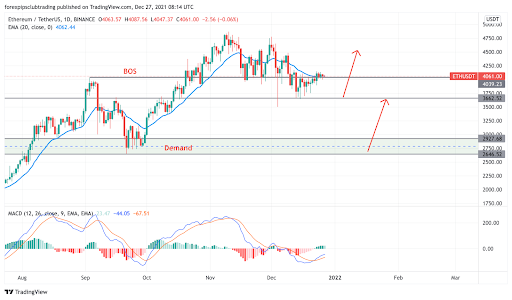
Ethereum (ETH/USD) is the native token of the Ethereum blockchain that has reached an all-time high at the $4868.00 level in November 2021. Since then, the price showed a corrective momentum where the current price stands at $4060.38.

Ethereum bullish factors: what investors should know

Ethereum transfer was more expensive a month ago, where users had to pay $22.80 or 0.0056 ETH per transaction. However, things have changed now, and the current transaction fee is $23.34, which is more than 62% lower than a month ago.

Ethereum investors passed a profitable year in 2021 that came from the massive surge in Web3 and NFTs. According to some crypto enthusiasts, Ethereum is a technology that has a more stable database than Bitcoin. The current key price driver for Ethereum is the upcoming “Protocol 2.0,” where the current energy-intensive “proof of word” will be shifted to the Proof of stake method. As a result, the Ethereum mining energy consumption might fall by 99% that would massively adopt users with a future price appreciation.

Should you buy Ethereum (ETH)?

Ethereum showed a decent return in 2021, where the price displayed a 400% gain compared to its rival Bitcoin, which barely provided an 80% YTD return. Moreover, the most recent price swing has a bullish break of structure at the 4060.00 level, a significant buying factor of the ETH/USDT price.

Source – TradingView

Although the current price is facing a dynamic resistance from the 20 EMA, we expect intense buying pressure in the coming days. In that case, any bullish rejection in the daily chart from 3662.52 support of 2927.68- 2646.52 demand zone has a higher possibility of extending the current bullish vibe above the 5000.00 psychological level.

The post Is Ethereum (ETH) a buy after the gas fees are down? appeared first on Coin Journal.

Polygon co-founder on DeFi applications, NFTs on the Ethereum layer 2 solution

  • All the popular dApps on Ethereum are now using Polygon, says co-founder Sandeep Nailwal

  • The latest Ethereum-based dApp to look to the layer-2 solution is the leading decentralised exchange platform Uniswap

  • He says sharding when it finally happens, might not help Ethereum scale “enough” to navigate the current challenges of a slow network and high gas prices.

Polygon co-founder Sandeep Nailwal has said that all the major decentralised finance (DeFi) applications built on the Ethereum network now use the layer two protocol, with Uniswap the latest to signal that move.

Nailwal made the comments during a recent interview, noting that the Polygon network offers the scalability and low gas fees that developers and users are after as Ethereum continues to see network limitations related to congestion and high gas fees.

Asked to comment about some of the DeFi projects currently using the Polygon network, Nailwal noted that “all” the Ethereum-based DeFi protocols were using Polygon. He said that even Uniswap, the leading decentralised exchange built on Ethereum has its community looking to launch on Polygon blockchain.

He pointed out that as for the popular dApps; the major ones currently using the layer-two solution are Uniswap (UNI), Aave (AAVE), and Decentraland (MANA).  According to him, about $5 billion to $6 billion is currently the total value locked (TVL) across all the bridges using the blockchain.

Polygon fees is “a fraction of a penny”

Nailwal also compared gas fees and network transaction speeds between Polygon and Ethereum. Users pay 0.001 MATIC in gas fees on Polygon, a “fraction of a penny” compared to the huge gas prices that users often have to bear while using the Ethereum network, he explained.

Of the issue of network speed, he noted that Polygon’s block time is around 2.3 seconds, compared to Ethereum’s 15 seconds. In his view, even ETH 2.0 might not immediately help solve the problem of scalability.

He believes that Ethereum’s switch to a proof-of-stake (PoS) network will not change much in the way of transactions per second (TPS). He sees the leading smart contract’s speed probably go from 13 to 20 TPS.

Will sharding scale Ethereum “enough”

According to the Polygon co-founder, that’s unlikely. He notes that ETH 2.0 might succeed in increasing throughput to 20 transactions per second, still too low and that wouldn’t change that much even when sharding finally happens in three to five years.

A quick calculation of a projected 64 shards and 20 TPS for each would only bring the speed to 1,280 transactions per second, he opined.

That’s still not enough for the entire world,” he added during the interview.

Dolce and Gabbana, Elon Musk and Jack Dorsey minted NFTs on Polygon

Nailwal also talked about non-fungible tokens (NFTs), saying that six to seven out of 10 gaming companies are building NFTs on the network. So far, the most notable drop being that of Dolce and Gabbana, which minted and sold one for $7 million.

Other recognisable NFTs minted on the blockchain include those by Tesla CEO Elon Musk, Block’s Jack Dorsey (the former Twitter CEO minted an NFT of his very first tweet) and billionaire investor Mark Cuban.

The post Polygon co-founder on DeFi applications, NFTs on the Ethereum layer 2 solution appeared first on Coin Journal.