Technical analyst says Bitcoin risks another 22% rout after snapping key level

The analyst says another leg down for Bitcoin could bring the $30,000 support level into play.

Bitcoin price fell to lows of $34,800 on Friday to extend its decline that now risks further losses to $30,000.  

Currently, the BTC/USD pair is hovering around $34,825, nearly 12% down in 24 hours and just over 20% in the red this past week. 

The broader crypto market also remains on track for its worst weekly performance since mid-December. At the time of writing, the total cryptocurrency market cap is at $1.7 trillion after a 14% rout in 24 hours. 

All the top 10 largest cryptocurrencies by market cap have logged double-digit losses on the day.

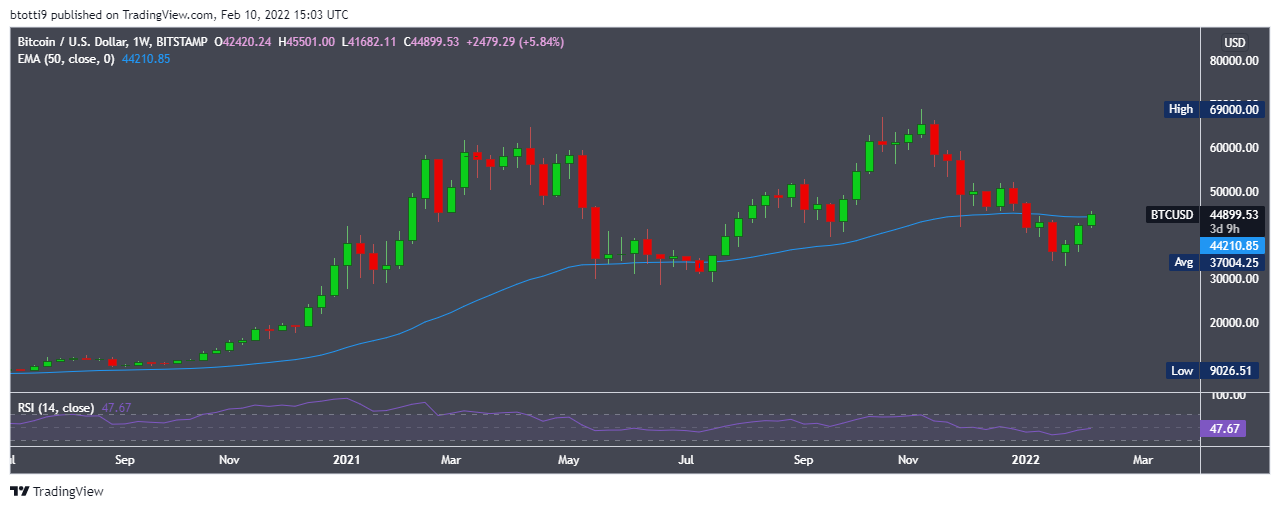
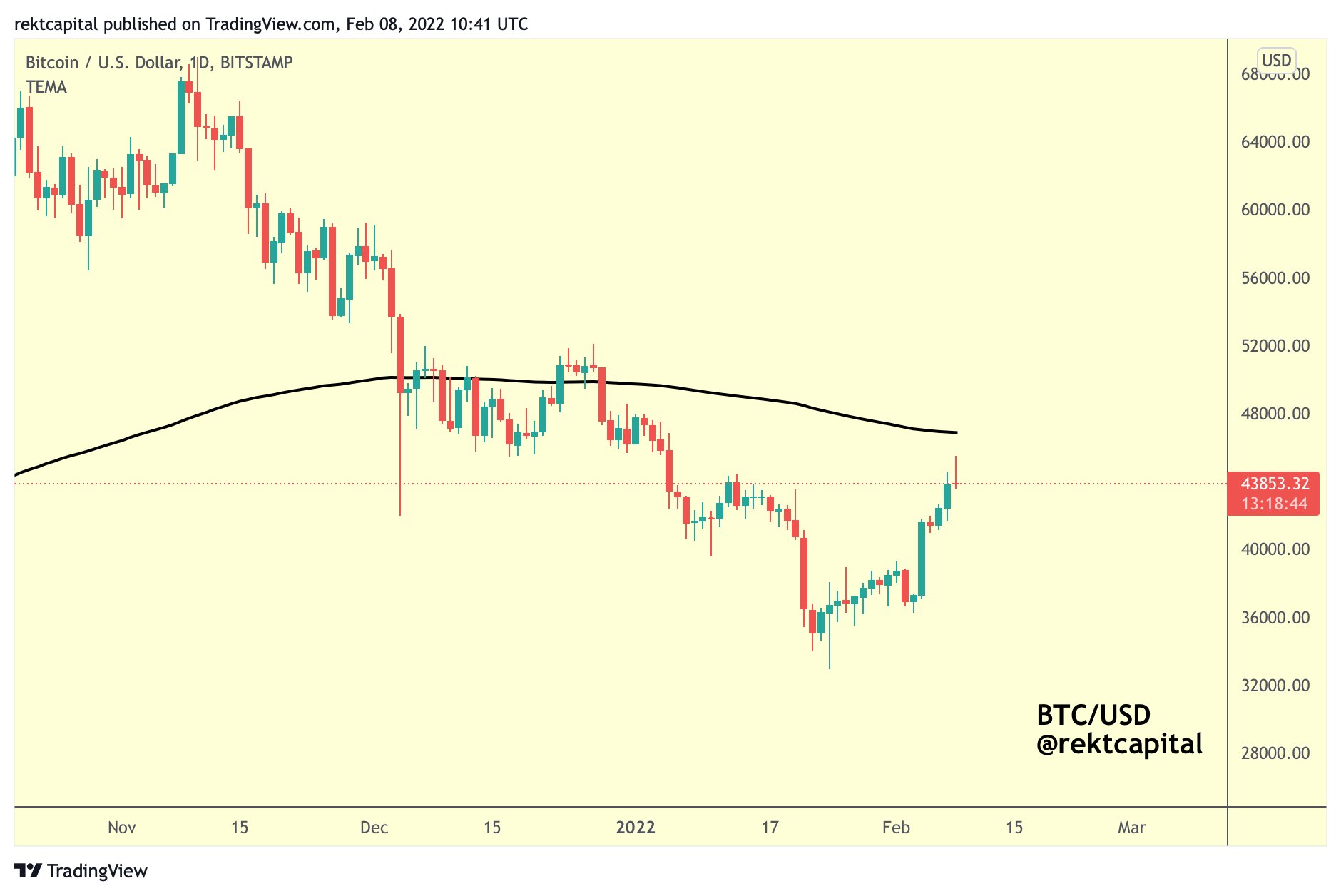
Technical analyst Katie Stockton of Fairlead Strategies told Insider on Friday that breaking below $40,000 could see bulls seek support around $37,361. She said that a breakdown to this “secondary support level” would see the flagship cryptocurrency’s overall decline total 22% from the recent highs to $30,000.

In a note to Insider, Stockton highlighted the area around $37k as one that presented a significant buffer zone. It also characterises the benchmark digital asset’s long-term uptrend line, below which lies the potential for more pain.

But she also noted that a rebound for BTC/USD that leads to a weekly close above $37,361 would likely invalidate the negative outlook. The analyst points to the technical picture that show oversold conditions as one likely to aid a short-term uptick in price movement.

However, things will be tough for bulls if the downturn leads to further rot and turns the highlighted level into a supply wall. According to the analyst, whose forecast came before BTC’s plunge to $35,262, another leg down would signal the start of a fresh bearish reversal.

The bearish run for crypto comes as the stock market also sinks amid increased risk aversion among investors. The drawdown across risky assets has heightened as the market prepares for the first of potentially three or more Federal Reserve interest rate hikes.

On Friday, crypto billionaire and Galaxy Digital CEO Mike Novogratz said that crypto faced a rough time and could potentially only rally once stocks „find a base.“ Investors might thus watch the stock market keenly next week even as the Fed’s January meeting takes place.

The Nasdaq closed 2.2% down on Friday, while the S&P 500 and Dow also edged lower by more than 1% to see stocks post another negative week. 

The post Technical analyst says Bitcoin risks another 22% rout after snapping key level appeared first on Coin Journal.

Crypto will have a hard time rallying until stocks find a base, says Mike Novogratz

Crypto billionaire Mike Novogratz says markets are now in bear territory after recent sell-offs.

In December last year, Galaxy Digital CEO Mike Novogratz said Bitcoin needed to hold support at the $42,000 level or risk further declines below $40,000. In a bullish outlook for crypto, the crypto billionaire noted that the pullback would however present a decent buying opportunity for institutional investors.

This week has seen the broader crypto market track sell-off pressure in the equities, with Bitcoin and Ethereum both sliding below key support levels.

According to Novogratz, the tumbling stocks have exacerbated the negative outlook across crypto and the drawdown seen in Nasdaq and other stock indexes means the bear market is here.

Commenting on the crypto market outlook as well as the sell-off on Wall Street, he noted:

The Russel index broke a major support and today’s roll over confirmed it’s broken. This is now a bear market. There is 1.2tr of bad equity longs above the market. Sell rallies. Don’t buy dips.”

Earlier, he had pointed to the retreating yields and the general downturn in the bond market and the impending interest rate hikes as spelling bad news for Nasdaq and cryptocurrencies.

However, he stated that the stock market and crypto would remain vulnerable to further rot if rates went up. To him, higher rates would see the 10-year Treasury yields jump to 2%, squeezing crypto and stocks lower.

Despite this projection, the Galaxy Digital chief believes cryptocurrencies have a chance at bouncing from recent lows. He notes that the crypto space has already felt the pain and currently looks set for “some buying pressure.”

But he warns the expected upside might not come unless the stock market stems the slide seen year-to-date. If the stocks continue to tank, Novogratz forecasts a “hard time.” He believes that a scenario where stock markets sink even deeper would limit any potential rally for crypto.

All the top ten cryptocurrencies by market cap are currently down double digits. The sell-off has wiped billions off the total crypto market capitalisation, cutting it by 11% to push it below the $2 trillion mark.

According to Stash CEO Brandon Krieg, the sharp declines across crypto offer a „perfect“ opportunity for retail investors to get exposure to cryptocurrencies.

In stocks, the Nasdaq is down 2.4% on Friday after entering a correction earlier in the week with a 10% slump. The S&P 500 is also tracking huge losses for the week, currently 1.4% down.

The post Crypto will have a hard time rallying until stocks find a base, says Mike Novogratz appeared first on Coin Journal.

Bitcoin’s price could deflate below $30,000 in 2022, Invesco says

Invesco’s Global Head of Asset Allocation likens Bitcoin’s staggering rally in 2021 to a financial mania, saying it could deflate to see BTC reach lows of $30,000 by October.

Bitcoin’s price could drop below $30,000 this year if the crypto bubble bursts and follows historical patterns seen in other crashes, an investment strategist at Invesco has said.

According to Paul Jackson, the Global Head of Asset Allocation at the investment firm, there is a possibility of this happening as the “mania” that drove Bitcoin to highs of $69,000 in November wanes.

In his forecast of the “improbable but possible outcomes for 2022”, Jackson says the year could see BTC price eventually post a 45% dump from its peak. And with bubble crashes extending for much longer, it’s probable the flagship cryptocurrency could end up valued at less than $30,000 from around October.

The mass marketing of bitcoin reminds us of the activity of stockbrokers in the run-up to the 1929 crash,“ the Invesco strategist said.

The reference to 1929 relates to the stock market crash that hit Wall Street beginning Black Thursday on 24 October. By the following week, Black Tuesday happened as a sharp sell-off wiped off billions of dollars from the market.

We know how that ended and Bitcoin has already fallen to around $42,000 (as of 7 January 2022), following closely the downward path of our mania template,” he added.

Jackson said that a bubble crash template features a 45% dip that occurs over the 12 months following an asset’s peak, which he called “a typical financial mania.“

In this case, he speculated, Bitcoin price could decline to lows of $37,000-$34,000 by the end of October. He then believes a potential trajectory tracking historical bubble patterns could push BTC below the $30k level given typical booms extend their burst over a further two years.

Hence, we think it is not too much of a stretch to imagine Bitcoin falling below $USD 30,000 this year,” he stated.

But Jackson was quick to note that the forecast could still be wrong, as was the case of last year’s prediction of Bitcoin diving below $10,000. According to him, there’s a “healthy chance” of the cryptocurrency tagging last year’s upside cycle.

Bitcoin fell below $40,000 earlier last week but quickly rebounded to test resistance near $44,000. The cryptocurrency’s price has however tracked sentiment across the broader markets.

Analysts have pointed out that Bitcoin has been trading in lockstep with stocks, suggesting a fresh decline in traditional assets could be replicated in crypto or vice versa. Since late last year, one of the macro pressures on equities has been the Fed’s indication of an interest rate hike in Q1, expected to be early March.

Bitcoin is trading around $41,685 as of writing, nearly 3% down in the past 24 hours.

The post Bitcoin’s price could deflate below $30,000 in 2022, Invesco says appeared first on Coin Journal.

Top 10 Most Popular Cryptocurrencies in 2022 So Far

The most popular are usually the ones with the highest market cap. Of course, people already know about them, and that’s why they’re in them. This market cap is usually over $10 billion. That’s how much capital investors have pumped into the crypto asset in the market. You can get the market cap by multiplying the unit price of the coin now by its supply in circulation. But this is not a math class. And before I bore you with all the statistical details, let’s dive right into the top 10 most popular cryptocurrencies in 2022.

1. Bitcoin (BTC)

If we’re going by market cap, you can already guess that Bitcoin comes on top of our list. Even besides that, Bitcoin owes a lot of its popularity to the fact that it was the first cryptocurrency. It was created in 2009 by Satoshi Nakamoto as the first money without any central authority. The first fully decentralised system and the first successful application of blockchain technology. Sounds like a superstar to me. And indeed, it is.

A total supply of 21 million has been programmed for circulation, but 18.9 million is now in circulation. Today, one Bitcoin is worth $42,557.00. It has a market cap of $801.7 billion with a trading volume of $29.1 billion. A similar asset to Bitcoin is Litecoin.

2. Ethereum (ETH)

 The second most popular cryptocurrency so far is Ether (ETH). If Bitcoin was the first payment blockchain, Ethereum was the first smart contract network. It was launched in July 2019 to support decentralised applications and smart contracts. Although it runs on a proof-of-work algorithm now, the Eth2 upgrade will feature a proof-of-stake mining model.

 ETH fuels the blockchain asides from serving as a currency. Today, ETH costs $3,301.70 and has a market cap of $394.4 billion. It has an uncapped supply with around 119.2 million ethers in circulation now. It is listed on most exchanges.

3. Binance Coin (BNB)

 The third most popular coin is the native token of the Binance exchange. It was created using the ERC-20 standard. BNB is a utility token for settling trading, listing, exchange, and other fees on the Binance ecosystem.

 BNB was introduced in July 2017 with an ICO that lasted for a month. Out of the 200 million total supply, 31.8 million has been burnt as a deflationary mechanism. BNB costs $483.43 right now. It has a market cap of $80.9 billion.

4. Tether (USDT)

 Tether is the first and one of the most popular stablecoins. It has a market cap of $78.7 billion, with a trading volume of $56.4 billion. In July 2018, it peaked at $1.32. It is worth $1.00 right now.

 It was launched in 2014 as RealCoin and started trading in February 2015. Tether is not highly volatile like most cryptocurrencies as it is pegged to USD. Also, it eliminates transaction costs and makes trade execution fast. It is listed on numerous exchanges.

5. Solana (SOL)

 The „Ethereum Killer“ was developed by Anatoly Yakovenko in 2017 as a fast, scalable, and secure platform. It can support the creation of decentralised applications, NFT marketplaces, DeFi, and the likes. The blockchain operates on proof-of-stake and proof-of-history consensus algorithms. Its native coin (SOL) has a market cap of $46.06 billion.

 SOL reached an ATH of $259.96 in November 2021. Today, it is trading at $146.10 per SOL. 313.5 million sols are in circulation right now. It is used as a governance token to settle transaction costs and staking.

 It is listed on Huobi Global, KuCoin, Coinbase Exchange, and Binance.

6. USD Coin (USDC)

 USD Coin is the second most popular stablecoin after USDT. It was launched in 2018 by CENTRE and is pegged to USD also. Initially, it was an ERC-20 token but is now on Algorand ASA, Solana SPL, and Stellar. It can be traded, held, or used in dApps and DeFi.

 It is worth $1.00 right now, but it peaked at $1.17 in May 2019. It has a market cap of $45.1 billion and a trading volume of $2.7 billion. There are 45.1 billion available in circulation currently. It is on DEXs and CEXs.

7. Cardano (ADA)

 Cardano’s native coin (ADA) is the 7th most popular coin with a market cap of $40.56 billion today. It costs $1.27 now after dropping by 59% from an ATH of $3.09 in September 2021. ADA allows users of the Cardano blockchain to perform transactions and participate in governance on the network. It can also be staked.

 Cardano is the first blockchain to use the Ouroboros consensus algorithm. It was developed in 2017 by Charles Hoskinson and Jeremy Wood. It supports the development of dApps with its ledger and smart contracts. The blockchain has two cores, the settlement and computational layers, which aid its operations.

8. Ripple (XRP)

 Like BTC, XRP was created for settling payments. It is the native token of the XRP Ledger and other services by the Ripple Labs. Unlike most blockchains, validation is somewhat centralised on Ripple. It has a list of nodes where users can validate their transactions.

 XRP is used to run trades on the XRP Ledger. It is worth $0.77 today, with a market cap of $36.9 billion now. It reached an ATH of $3.40 in January 2018. There are 47.6 billion of the pre-mined 100 billion in circulation right now.

9. Polkadot (DOT)

 Polkadot was created in 2016 and launched in May 2020 by Robert Habermeier, Peter Czaban, and Gavin Wood. It boasts of security, scalability, and decentralisation. It operates on a Nominated-Proof-of-Stake (NPoS) consensus mechanism.

 DOT is its native cryptocurrency. It can be traded, staked, and used as a governance token. The price of DOT is $26.28 right now but reached an ATH of $54.98 in November 2021. It has a market cap of $29.4 billion.

10. Terra (LUNA)

Terra is a blockchain that supports the creation of stablecoins. They can be traded and exchanged on the ecosystem or various exchanges. Terraform Labs created it. It runs on Tendermint Delegated-Proof-of-Stake (DPoS) consensus algorithm.

 The ecosystem consists of CHAI, Anchor Protocol, Terra Bridge, and Mirror Protocol. LUNA is its native token for making stablecoins stable. The total supply of LUNA is less than a billion. LUNA costs $80.47 as of today and has a market cap of $28.9 billion.

 If you are looking for stable cryptocurrencies to invest in, these ten coins are your best bet. They have high market caps and more security benefits. However, don’t take my word for it. Make sure to do in-depth research and average your spending before investing in any cryptocurrency.

The post Top 10 Most Popular Cryptocurrencies in 2022 So Far appeared first on Coin Journal.

Bitcoin is ‘a tool for social justice’: ex-Fed official

  • Communities can now create wealth and move towards financial freedom by investing in Bitcoin, the former audit manager at the Fed said.

  • She noted that crypto allows people in Black and Latino communities to access wealth that is otherwise inaccessible via the traditional financial system.

Bitcoin has been singled out as a tool for creating generational wealth and imparting financial freedom to all, according to Charlene Fadirepo, a former manager at the Federal Reserve Board of Governors.

Fadirepo is also the founder of the fintech platform Guidefi, whose main goal is to allow women and other professionals within the community access financial and investment advice.

In an interview with Yahoo Finance this week, Fadirepo said the flagship cryptocurrency was “absolutely a tool for social justice.”

The former auditor at the US central bank believes that Bitcoin has given Black Americans and Latino Americans, particularly, access to financial tools largely inaccessible via legacy banks.

Last week, a report by MarketWatch revealed that there’s a growing gap along racial lines when it comes to access to credit in the US. According to the report, people of color (blacks) fail to secure a mortgage 84% more compared to white applicants. 

[Bitcoin] allows communities to build wealth in communities that have been left out of the discriminatory banking system,” she told Finance Yahoo.

She also believes Bitcoin is set for further growth as more institutional money flows into the crypto industry. According to her, 2022 and beyond will continue to see more investors look at Bitcoin as an asset class.

Once that explodes and more institutions and high-net-worth individuals add BTC to their balance sheets, Bitcoin’s “big picture” will brighten even more.

She also talked about Bitcoin’s price over the past two years, comparing it with that of gold. On a 10-year basis, the benchmark cryptocurrency posted annualised returns of 200%, with 2020-2021 seeing an uptick of about 400%.

In comparison, gold’s return over the pandemic period is around 15% while in stocks, the S&P returned roughly 42%.

Individuals can invest in Bitcoin by buying the cryptocurrency and holding it for future returns or trading it on brokerages and exchanges. Some also reap huge benefits through Bitcoin mining.

Fadirepo also weighed in on the issue of crypto regulation, noting that regulatory clarity will help build trust, enhance consumer protection, and ultimately, attract more retail and institutional investors.

Apart from Bitcoin, other sectors of the crypto ecosystem providing a route to financial freedom are decentralised finance (DeFi) and non-fungible tokens (NFTs). In 2021, the NFTs industry saw sales of over $44 billion, according to a Chainalysis report.

The post Bitcoin is ‘a tool for social justice’: ex-Fed official appeared first on Coin Journal.