Crypto spot trading: The Best coins to consider in it

Spot trading has become one of the most common ways to buy and sell crypto. Although spot trading has its risks, it has low barriers of entry and is open to literally everyone. But you need to be very careful when choosing assets for spot trading. Here are some attributes to consider:

  • Cryptos for spot trading must have very high trading volumes

  • You also want highly volatile assets that swing fast.

  • The assets must also be available in all major centralized exchanges.

With that said, if you are thinking of dipping your toes into the world of crypto spot trading, these are some of the best coins to consider:

Bitcoin (BTC)

Bitcoin (BTC) is the biggest crypto and one of the most recognizable in the world. If you are going to spot trade, then BTC will need to be part of that calculus. The most important thing about BTC is the large daily trade volume.

This means that there is enough liquidity in the market to ensure orders to buy or sell are filled with minimum or no slippage. BTC is also spot traded in the biggest exchanges in the world and is accessible to everyone.

Bitcoin Cash (BCH)

Bitcoin Cash (BCH) was created to provide the foundations over which payment systems can be developed in the decentralized economy. It’s related to Bitcoin in a way, but it is an asset of its own. However, just like BTC, BCH has large trade volumes each day. There is also a huge market cap to deal with so chances of making returns are high.

Shiba Inu (SHIB)

Meme coins have always been great for short-term speculative trading, and there is no better meme coin out there than Shiba Inu (SHIB). The token is prone to a lot of daily volatility and trade volume as well. SHIB can also be purchased from a lot of exchanges.

The post Crypto spot trading: The Best coins to consider in it appeared first on Coin Journal.

Goldman Sachs executes first over-the-counter crypto trade

Goldman’s over-the-counter crypto transaction was facilitated by Michael Novogratz’s Galaxy Digital Holdings.

Goldman Sachs is said to have completed its first over-the-counter crypto derivatives trade, the first major US bank to dive into the growing crypto options market.

The development came to light on Monday and saw the bank make the maiden OTC crypto trade featuring a type of BTC derivative that settles in cash.

According to a report by CNBC, Goldman teamed up with Galaxy Digital to successfully execute the non-deliverable Bitcoin option. 

SkyBridge Capital’s Anthony Scaramucci pointed out that Galaxy Digital also helped it handle its first OTC crypto trade.

Crypto has matured as an asset class

This is not the first time Goldman Sachs, which already allows its clients access to non-deliverable forwards and exchange-traded options. 

However, the OTC trade is the ‚first big move‘ to highlight the increased interest in crypto investment products from institutional investors. It also comes as traditional finance continues to show a flip in sentiment towards digital assets.

Goldman’s Max Minton, the bank’s head of digital assets for Asia Pacific, said in a statement that the trade is an indicator that crypto as an asset class is mature. And he noted that the OTC trade marks an important milestone for the bank’s overall plans around digital assets, which he revealed to revolve around the crypto options market.

Galaxy co-President Damien Vanderwilt noted that Goldman’s Bitcoin crypto OTC trade marks the first step in major bank’s involvement, with clients set to benefit from more “direct, customisable exposures to the crypto market.”

Bitcoin and other crypto-assets continue to see greater interest after initial apathy from mainstream investors, including legacy financial institutions. 

Today, several major banks, hedge funds, endowments, family offices and sovereign wealth funds have crypto as a slice of their portfolios.

The post Goldman Sachs executes first over-the-counter crypto trade appeared first on Coin Journal.

Could this on-chain metric catapult Ethereum’s price?

As another week comes to a close in this eventful macroeconomic climate, let’s take a look at how the world of cryptocurrency looks, before we all take a breath over the weekend.

Key Points

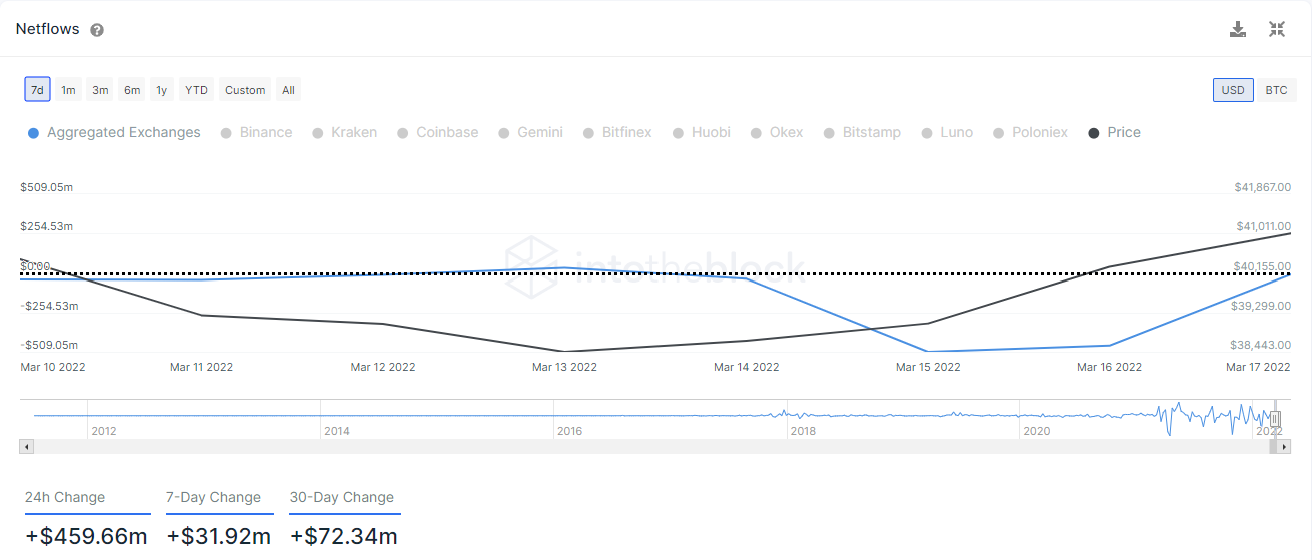
  • Bitcoin net outflows from exchanges breach $1 billion for the week
  • Tuesday sees highest daily outflows in ETH since October
  • Moderate uptick in new and active addresses for Bitcoin

Bitcoin

Net Flows
Data via IntoTheBlock

A nice milestone for Bitcoin this week, as net outflows from exchanges breached the billion dollar mark, as displayed on above graph. One of the go-to indicators of sentiment, a net outflow from exchanges typically means accumulation, while a net inflow signals selling pressure.

Volatility

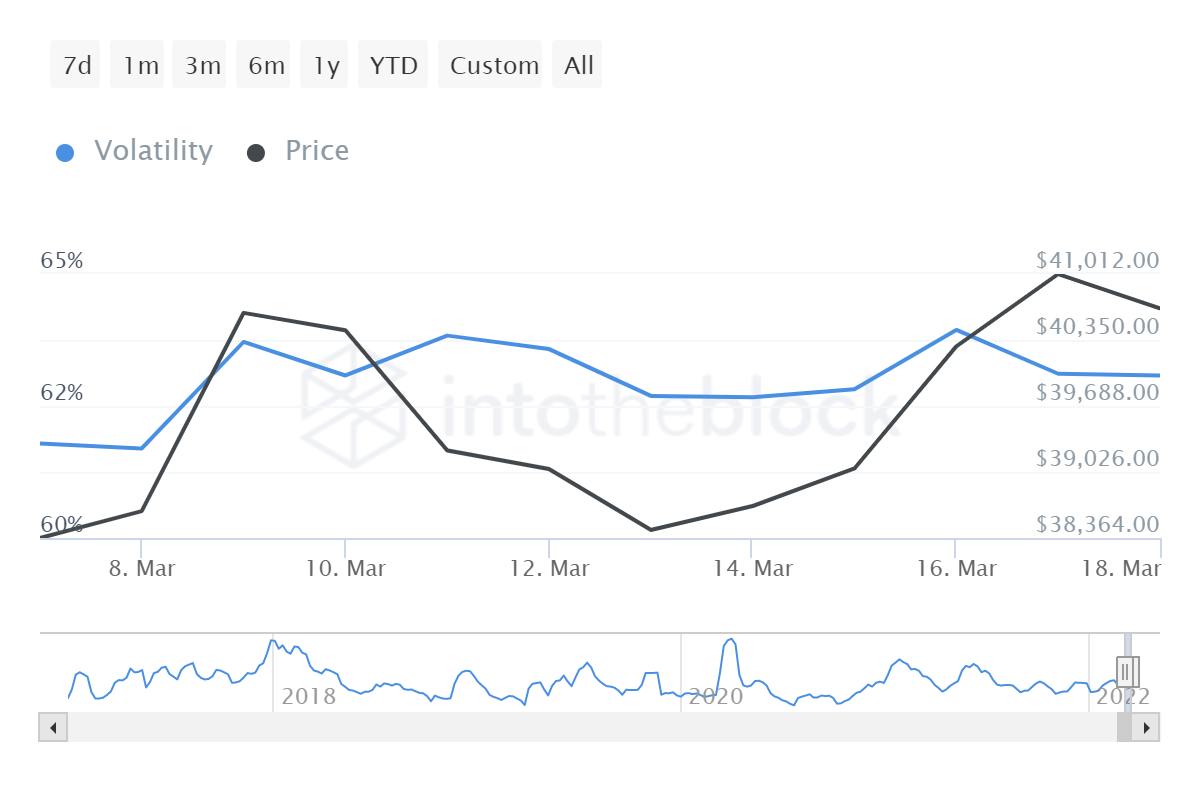
Price-wise, we “closed” last Friday at $39,200, while currently we sit at $40,700. Looking at volatility, the 30-day annualised standard deviation remained relatively stable at circa 63%. This is shown on the below graph, but if we want to translate these numbers to simple English, we can simply say that this week Bitcoin was … chill. As the world seems to be falling down around it, Bitcoin has been actually been quite well behaved. Who would have thought?
Data via IntoTheBlock

Addresses

Some moderate uptick here too, with an 11% increase in new addresses since last week. Active addresses were relatively stable (up 3%) and there was a fall of 2% in zero-balance addresses. All pointing, again, to a steady but unspectacular week for Bitcoin. If only all the weeks were like this – this must be what it feels like to hold stocks, right? Maybe next week we will get some more movement, helping to make this piece a little more entertaining! 
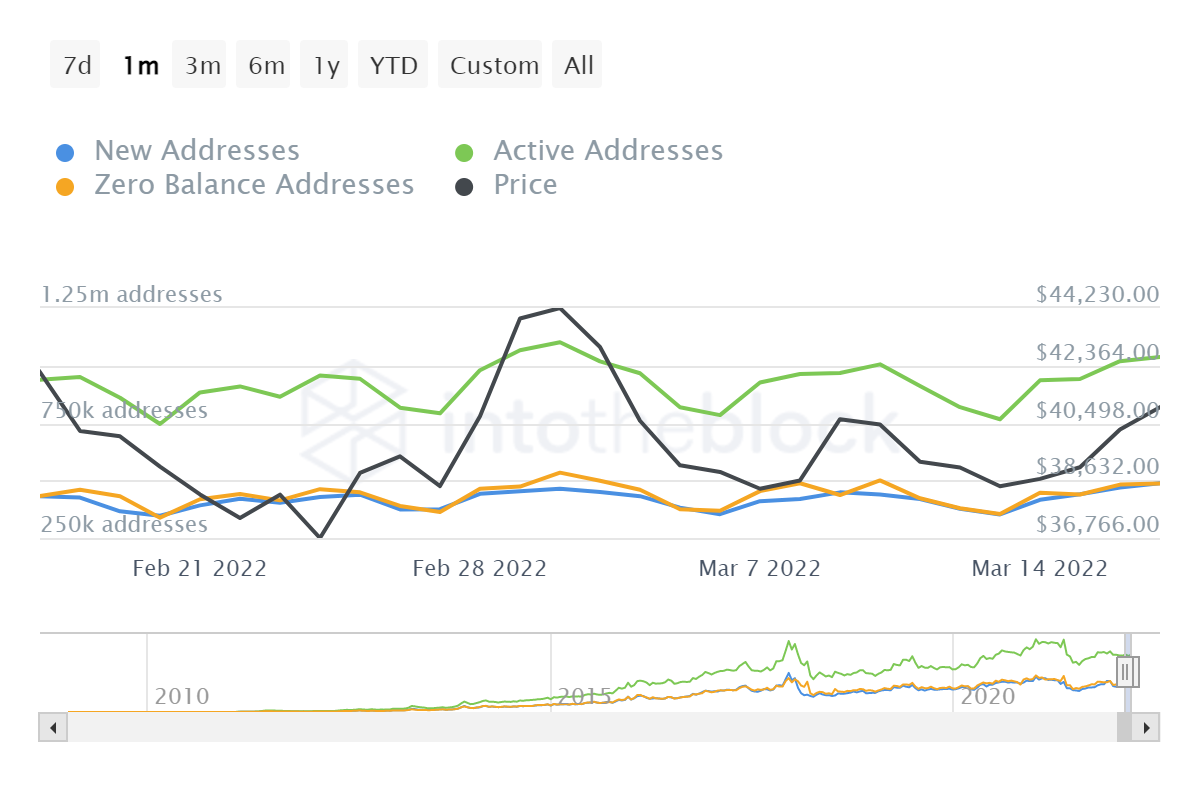
Data via IntoTheBlock

Ethereum

Let’s see if we can poke around with Ethereum a little and uncover any trends.

Net Flows

There was nice net volume here too, with close to a billion dollars flowing out of exchanges over the last week. This was buoyed mainly by Wednesday, which saw $448 million in net outflows. For context, in dollar terms that’s the 24th largest daily outflow volume ever – and the second largest this year. 
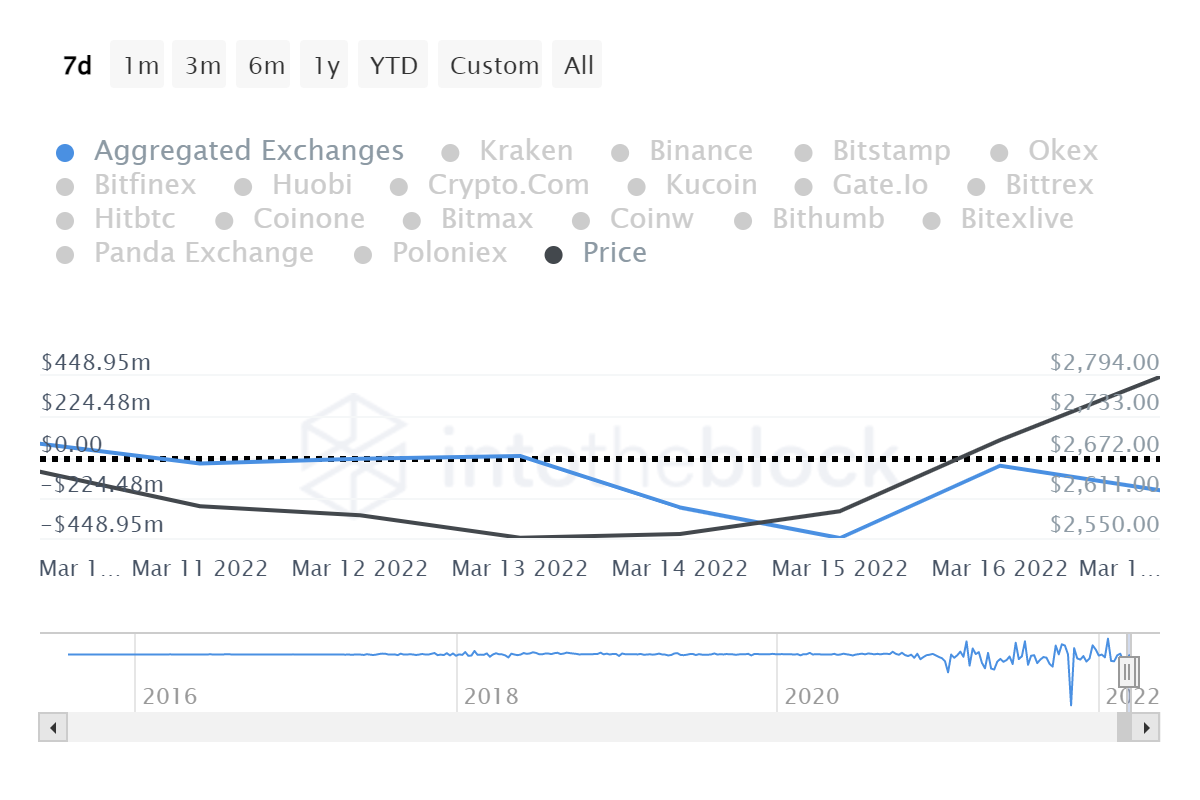
Data via IntoTheBlock

Precedent

The largest of 2022, you may be wondering, was January 4th. Known as “Blue Monday”, they say it’s the most depressing day of the year – the return to work after the holidays. Apparently, people settled down to their computers to withdraw their crypto gifts into their cold wallets this year. Unfortunately, Ethereum plunged 21% in the next four days – so let’s hope that’s not a signal of what’s to come here.

I’m not really sure what exactly caused such a spike this Tuesday, given the lack of activity elsewhere. Maybe, just maybe, it’s plain old coincidence, huh? Or maybe somebody was afraid they would be tempted to redeem their ETH to buy a load of Guinness ahead of St Patrick’s Day. I don’t know.

Denominated in ETH terms, however, it marks the largest daily withdrawal since last October, at close to 180,000 ETH. In Ocotober, Ethereum did the opposite to January– ramping 14% in just over a week. Although it’s important to note that at 750,000 ETH, the withdrawal last October was over 4X what we saw on Tuesday. The graph below highlights the size of this move compared to last October, as well as the price action (black line). So be careful with your conclusions.  
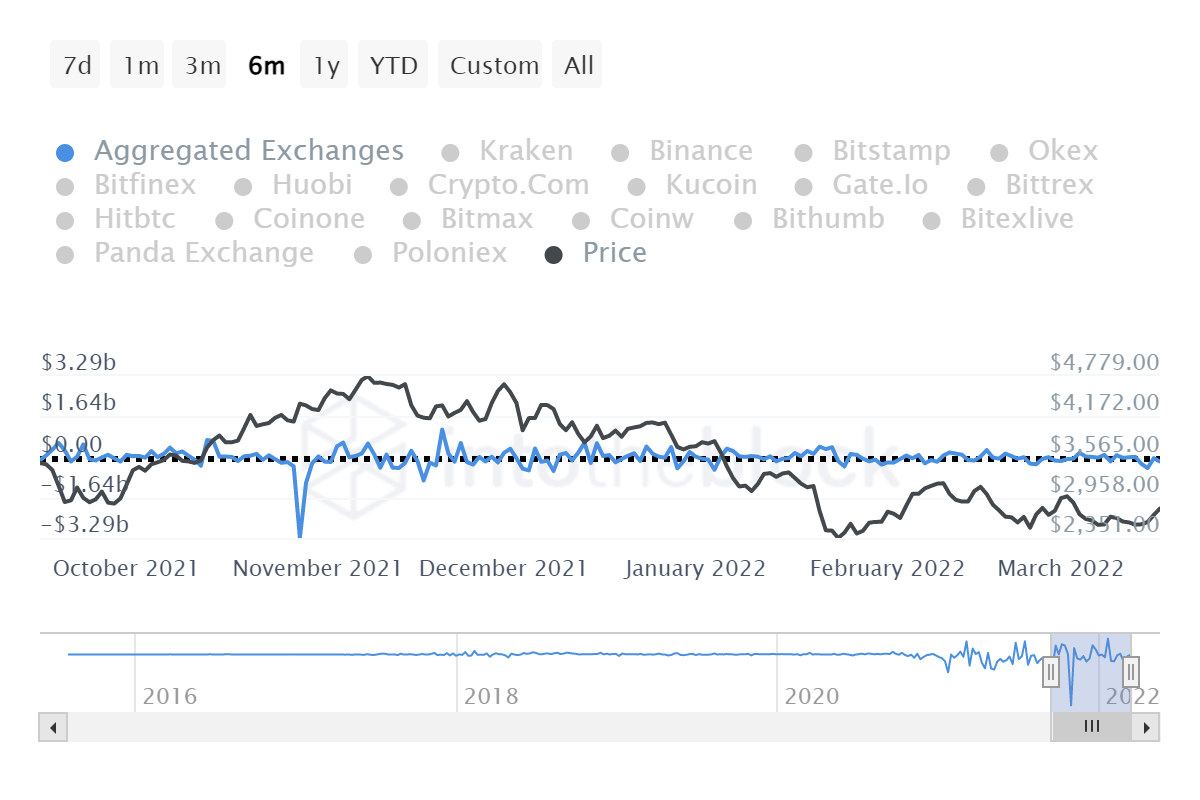
Data via IntoTheBlock

Closing Thoughts

So, a somewhat notable tidbit to close the week from Ethereum then. Bitcoin behaved, while the crypto markets largely followed. A nice week without too much volatility. If only they were all like this, I reckon my heart rate would be significantly lower. Then again, wouldn’t life be less fun?

Still, next time we get those ugly red candle days, I’ll look upon weeks like this with green-eyed envy. In crypto, it could always be worse. Happy Weekend !


The post Could this on-chain metric catapult Ethereum’s price? appeared first on Coin Journal.

Bitcoin (BTC) remains strong as new data shows institutional investors are buying the coin in droves

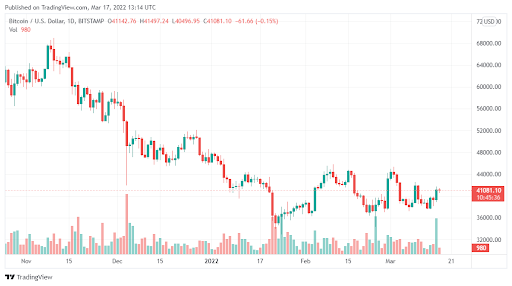
After the volatility that we saw over the last few weeks, it seems like Bitcoin (BTC) is starting to show a lot of resilience. The coin has regained $40, 000 and new data shows that the flow of institutional money is playing a big role in this. Here are the facts so far:

  • New data shows that nearly all trades in BTC consist of transactions above $100,000.

  • Institutional money has dominated BTC liquidity since 2020.

  • At press time, the coin was trading at $40,974, virtually unchanged in 24 hours.

Data Source: Tradingview 

Bitcoin (BTC) – is $50,000 in sight?

Early predictions for Bitcoin in 2022 were quite ambitious. There were some analysts who even thought that coin would hit $250,000 by the end of the year. In fact, the most conservative estimate had BTC at $100,000 by year-end. 

This could still happen. After all, we are not even in Q2. But the way the broader crypto market has started, Bitcoin will go through a wide period of volatility. It is highly unlikely that we will get to $50,000 in the near term. 

For most parts of 2022, BTC has largely bounced off between $45,000 and $35,000 and we expect this to remain the case for the foreseeable future. The flow of institutional money is also going to ramp up by the end of the year.

Why are institutions buying Bitcoin (BTC)?

Well, there are several reasons. For starters, the coin has dipped quite significantly from all-time highs. This provides large capital holders the perfect entry point to ride the Bitcoin and the crypto wave. 

But also, Bitcoin is a safe bet in the crypto market. It is seen as the gold standard and as such, institutions largely focus on it for the safety and longevity, it has to offer.

The post Bitcoin (BTC) remains strong as new data shows institutional investors are buying the coin in droves appeared first on Coin Journal.

Bitcoin falls below $40,000 as inflation in the US continues to pose major risks

The recent Bitcoin (BTC) rally has halted. After days on the up, the mega-cap coin has fallen below $40,000 once more. The drop has largely been attributed to growing inflation in the US and the threat of economic slowdown due to the crisis in Ukraine. Here are some highlights:

  • $40,000 is a key support, and BTC could see more weakness in the coming days.

  • US inflation is expected to hit 7.9%, higher than expected and the highest in 40 years.

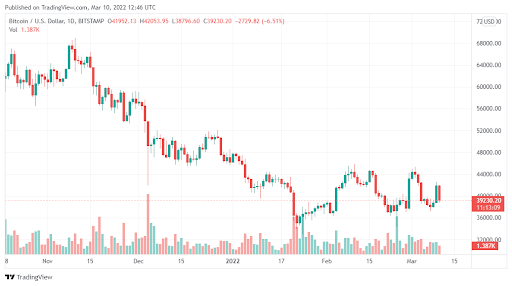
  • At press time, BTC was trading at $39, 200, down about 7% in 24 hours.

Data Source: Tradingview 

Will Bitcoin (BTC) fall further?

The last few weeks have been quite volatile for Bitcoin (BTC). However, even amidst this high volatility, $40,000 has remained a crucial support zone. Every time the mega-cap has fallen below this mark, it has gone on to slide further. 

Most analysts are watching the $37,000 mark. If weakness continues and BTC drops below $37,000, then you can expect it to bottom at around $32,000 before the next rally. But if bulls can somehow push the price action back up to $40,000, we may see some sustained resilience on BTC.

But with high US inflation, threats of economic slowdown, and the crisis in Ukraine, it is highly unlikely there is enough sustainable upward momentum for BTC.

Is this the best time to buy BTC?

Even with recent challenges, overall, the long-term outlook on Bitcoin looks very promising. There are in fact estimates that are looking at $100,000 before the end of 2022. Buying at $39,000 or thereabout could be a great idea. 

Even if BTC does not hit six figures in terms of value, there is a chance it will hit a new all-time high this year. This would still represent gains of over 100% from the current price.

The post Bitcoin falls below $40,000 as inflation in the US continues to pose major risks appeared first on Coin Journal.