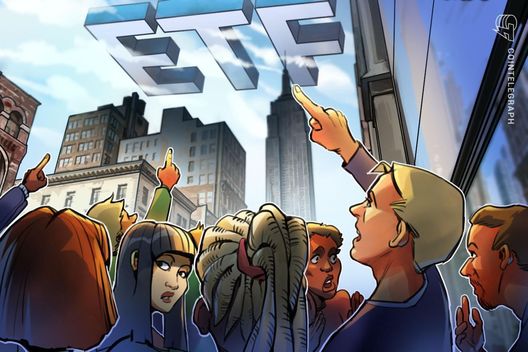
In Südkorea könnten schon bald Krypto-ETFs an den Start gehen, denn die KRX hält sich für diesen Schritt bereit, nur die Freigabe durch die Behörden fehlt noch.

Finanzmittel Info + Krypto + Geld + Gold
Krypto minen, NFT minten, Gold schürfen und Geld drucken
In Südkorea könnten schon bald Krypto-ETFs an den Start gehen, denn die KRX hält sich für diesen Schritt bereit, nur die Freigabe durch die Behörden fehlt noch.
Hedera entered the new year on a strong footing, with HBAR registering significant gains to touch multi-week highs at $0.12.
This comes after consolidating below $0.11 since the breakdown below the $0.12 threshold in mid-December.
Per trading data, Hedera has seen a surge in daily volume, which stood at over $166 million and was 38% up in the past 24 hours.
HBAR is notching gains as analysts attribute the rally to a combination of factors.
Among these is the broader market’s post-holiday portfolio rebalancing and fresh risk appetite.
The crypto project’s underlying network also continues to show robust activity, helped by enterprise partnerships and real-world asset tokenisation.
The surge to an intraday high above $0.12 could encourage bulls, particularly if risk assets flip the bearish sentiment seen in late 2025.
Looking ahead, several potential catalysts could drive further upside for HBAR throughout 2026.
Growing interest in exchange-traded funds (ETFs), including those focused on Hedera, has analysts bullish on several altcoins. Currently, spot HBAR ETFs are seeing small but steady inflows.
SoSoValue data indicates that over $50 million in ETF net assets represent over 1.1% of the token’s circulating supply.
Analysts anticipate that additional ETF approvals or increased allocations could inject substantial liquidity.
In this case, it would mean another regulated pathway for institutional investors to gain exposure to HBAR.
Beyond ETFs, Hedera’s enterprise adoption remains a core driver.
Institutional adoption was the major trend of 2025. For @Hedera, this has been the reality since inception.
From institutional-grade DeFi to Verifiable AI and well beyond – 2025 was a year of growth across the ecosystem 🧵 pic.twitter.com/ggZ1BQNScb
— Hedera Foundation (@HederaFndn) December 31, 2025
The platform saw significant traction around real-world applications in finance, supply chain, and tokenisation in 2025.
Upcoming milestones, including the expansion of the Governing Council and enhanced developer tools, are expected to accelerate ecosystem growth.
From a technical perspective, HBAR’s recent breakout above long-term resistance signals potential for continued gains.
Bulls are showing signs of retaking control as charts signal a double bottom in the $0.10-$0.11 region.
A key technical breakout from a multi-week consolidation pattern is what buyers fancy. The initial price targets are above the downtrend line around $0.13.
Hedera’s daily chart also shows that the 50-day exponential moving average sits in this region.

If momentum sustains, projections point to levels between $0.15 and $0.20 in the near term.
Broader market recovery and Hedera-specific advancements will drive this uptick. Notably, memecoins, as shown by a 35% pump for Pepe, could lead the early charge.
However, risks, including macroeconomic factors, may see bulls’ advances repelled. Key support levels include $0.10 and $0.079.
The post HBAR jumps to $0.12 as ETF inflows and enterprise demand revive Hedera’s bullish momentum appeared first on CoinJournal.
As of writing, Pepe ranked as the best performing memecoin among the top 100 by market cap.
The frog-themed token had recorded an impressive 35% gain in the past 24 hours, trading to intraday highs of $0.000005667.
Notably, Pepe’s price rally has been accompanied by a dramatic increase in trading activity.
Per CoinMarketCap, the Ethereum-based memecoin boasted a 24-hour volume of over $1.4 billion, the metric up a staggering 650% in the past 24 hours.
As bulls ride the uptick, short liquidations have amplified upward pressure. CoinGlass data shows over $10 million in liquidations for the token.
More than $9.1 million of this is in bearish positions.

Optimism around Pepe comes amid a bold prediction from James Wynn, a prominent trader on the Hyperliquid platform.
Wynn has forecast that the memecoin’s market capitalisation could reach an astonishing $69 billion by the end of 2026.
“Back on Day 1 of $PEPE when it was at $600k market cap, I called it to go to multiple billions. Ultimate conviction and belief – and it paid off massively,” he posted on X.
“Now, I’m calling $PEPE to go from $1.7bn to $69bn+ in 2026.”
It’s a bold take that suggests a potential 40-fold increase from its current level of around $1.7 billion.
As he notes, Pepe has the potential to mirror or even surpass what Shiba Inu did in the previous cycle.
The Pepe market cap has soared to above $2.3 billion hours after Wynn’s prediction.
If realised, this could mean the token’s price catapults past the all-time high of $0.00002825 reached in December 2024.
Wynn says a combination of technical, sentimental, and overall bullish catalysts positions Pepe well ahead of a fresh memecoin resurgence.
He noted:
“If this bull market is not over, which I do not think it is, there is a high likelihood in my mind we see $PEPE at the forefront of memes leading the way as money flows into T1 memes, and proper fundamental altcoins. All social metrics (crucial factor for meme coins) MASSIVELY favor Pepe, including exchanges using it as a branding in their posts to increase engagement and get more sign ups.”
In his view, if Shiba Inu can spike to $41 billion, PEPE has the potential to go higher.
Top memecoin Dogecoin soared to $88 billion when its price went parabolic, and Pepe could easily do $69 billion.
While Pepe dominates headlines, other established memecoins have also contributed to the sector’s strong opening to 2026.
Floki (FLOKI), bolstered by ongoing ecosystem developments, has seen a 19% increase in the past day.
Like Pepe, this comes alongside elevated trading volumes.
Another top gainer is Bonk (BONK), the Solana-based community token.
Renewed interest has BONK trading 15% up in the past 24 hours.
Meanwhile, SPX6900 (SPX), known for its satirical take on financial markets, has surged 16%.
Pudgy Penguins, Shiba Inu and Dogecoin are also boasting double-digit gains as the memecoin category as a whole witnesses a vibrant start to the year.
The post Pepe soars 35% as top memecoins lead market rally appeared first on CoinJournal.
Coinbase is entering 2026 with a platform that looks increasingly different from a traditional crypto exchange.
The company is placing greater emphasis on stablecoins, its Ethereum layer-2 network Base, and a wider range of trading products that stretch well beyond digital tokens.
The shift reflects how crypto platforms are adapting as growth in spot trading cools and competition intensifies.
Rather than positioning itself only as a gateway to cryptocurrencies, Coinbase is aligning its business around broader financial access, with trading, payments, and onchain activity increasingly converging inside a single ecosystem.
In a New Year’s post, Brian Armstrong reiterated Coinbase’s ambition to build what it calls an “everything exchange.”
The strategy focuses on expanding product lines so users can trade and interact with multiple asset classes from one interface.
That direction was formalised at the company’s year-end conference in December, where Coinbase rolled out stock trading and prediction markets.
These launches marked a clear move beyond cryptocurrencies and into areas traditionally dominated by retail brokerages and derivatives platforms.
Coinbase executives have framed the rollout of stock trading on the main app as a key step toward enabling round-the-clock access to markets, with crypto, equities, and exchange-traded funds sitting side by side.
Coinbase’s product push is not limited to its exchange. The company has rebranded its wallet as an “everything app,” adding social networking features and deeper onchain functionality.
The aim is to keep users active across more use cases, rather than relying solely on trading volumes.
The company has also launched onchain prediction markets in partnership with Kalshi, allowing users to participate in markets tied to real-world events.
Alongside this, Coinbase has flagged plans for perpetual futures that would cover both crypto assets and stocks.
These additions move the platform further into direct competition with firms that operate across equities, derivatives, and commodities, rather than only crypto-native rivals.
Stablecoins form a central part of Coinbase’s longer-term roadmap.
The company has described them as essential financial infrastructure, particularly for cross-border payments, payroll, and settlement.
Armstrong has said banks are likely to seek interest-bearing stablecoin products over time, underlining Coinbase’s view that stablecoins will play a growing role in mainstream finance.
Base, Coinbase’s Ethereum layer-2 network, is positioned as another pillar of this strategy.
The network is designed to support consumer applications, creators, and onchain services that can scale beyond Ethereum’s main chain.
However, Base’s handling of creator coins has attracted criticism from some developers, who argue the approach risks prioritising viral growth while the company promotes creators as a key onboarding channel.
The post Stablecoins, Base and ‘everything exchange’: a look inside Coinbase’s strategy to expand in 2026 appeared first on CoinJournal.

Auf Polymarket halten sich die Nutzer mit ihren Prognosen um die Kursentwicklung von Bitcoin in 2026 spürbar zurück.