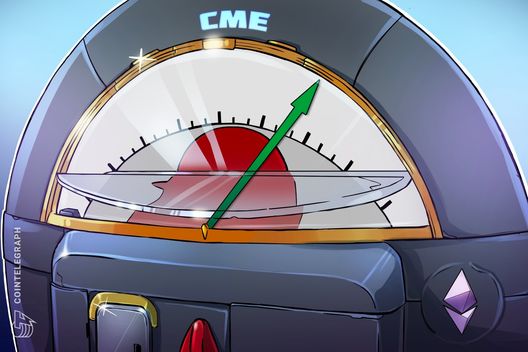
Ether-Futures überholen Bitcoin an der CME, da die Volatilität von ETH sprunghaft ansteigt und die Debatte über einen möglichen Ether-Superzyklus inmitten eines allgemeinen Rückgangs des Kryptomarktes anheizt.

Finanzmittel Info + Krypto + Geld + Gold
Krypto minen, NFT minten, Gold schürfen und Geld drucken
Ether-Futures überholen Bitcoin an der CME, da die Volatilität von ETH sprunghaft ansteigt und die Debatte über einen möglichen Ether-Superzyklus inmitten eines allgemeinen Rückgangs des Kryptomarktes anheizt.
Toncoin (TON) has reclaimed the $1.50 level as a broader market rebound lifts sentiment across major cryptocurrencies.
TON was trading near $1.51 on Tuesday, up about 1.5%, after Cocoon — a decentralized confidential compute network — went live on The Open Network.
The launch is viewed as a significant step for the TON ecosystem and aligns with Telegram’s push toward a private, decentralized AI framework.
The development has provided a fresh catalyst for bullish momentum, with the community looking to build on the optimism and potentially drive TON higher in the sessions ahead.
Toncoin slipped sharply after months of consolidating below $3.50 and $4.00, with sellers driving the token to a low of $1.45 on Monday, December 1, 2025.
The move mirrored the broader market’s November slowdown and the weaker start to the new month.
A modest recovery has followed. TON has edged back above $1.50, even as 24-hour trading volumes across major exchanges have fallen by about 10%.
The rebound is limited, but it gives buyers a narrow window to attempt a stronger move.
A continued bounce could open the way for a push toward $1.60, which may allow Toncoin to retest and potentially flip the earlier resistance zone around $2.36 into support.

Although Toncoin’s price remains vulnerable below $2.00, both traders and long-term holders are celebrating the arrival of Cocoon.
It is about real utility that ties GPU supply directly to TON token economics.
Per latest details, Cocoon has officially begun processing live user requests.
With the launch, the platform becomes the first decentralized artificial intelligence project on TON to offer fully confidential AI inference at scale.
Notably, the network enables GPU owners worldwide to rent out their hardware for privacy-preserving AI workloads, earning TON tokens as direct compensation.
Using Trusted Execution Environments (TEEs) and zero-knowledge proofs, Cocoon ensures that sensitive data never leaves the secure enclave.
In short, it eliminates the privacy risks and high costs associated with centralized providers like AWS or Google Cloud.
Telegram itself is Cocoon’s anchor client and first major user, routing select AI features through the decentralized network to guarantee end-to-end confidentiality for its nearly one billion users.
The post Toncoin eyes $2 as community cheers Cocoon launch on TON appeared first on CoinJournal.
Bitcoin’s latest retracement may already be stabilizing, with asset manager Grayscale arguing that the market is on track to break its traditional four-year halving cycle and could set fresh all-time highs in 2026.
Despite uncertainty following a 32% decline from recent peaks, emerging indicators suggest the current drawdown may be closer to a local bottom than the start of a prolonged downturn.
According to Grayscale’s Monday research report, Bitcoin’s performance in 2025 has already shown characteristics that diverge from the typical post-halving trend.
The firm believes the long-held four-year cycle thesis is likely to prove incorrect and that Bitcoin may reach new highs next year.
One of the key signals cited is the elevated Bitcoin option skew, which has risen above 4.
This level indicates investors have already hedged extensively against additional downside, often a sign that selling pressure may be thinning out.
Grayscale argues that although the broader outlook remains uncertain, current dynamics support the case for a cyclical shift.
Still, analysts warn that a sustained recovery hinges on meaningful reversals in several major flow metrics.
These include futures open interest, ETF inflows, and selling activity from long-term Bitcoin holders—all of which have pressured prices in recent weeks.
US spot Bitcoin ETFs, a major driver of the asset’s momentum throughout 2025, placed substantial downward pressure on the market in November.
The products recorded $3.48 billion in net outflows during their second-worst month on record, according to data from Farside Investors.
However, the trend has begun to reverse.
The funds have now posted four consecutive days of inflows, including a modest $8.5 million on Monday.
While early, the shift suggests investor interest may be gradually recovering following the recent sell-off.
Market positioning reflects what Nexo analyst Iliya Kalchev calls a “leverage reset rather than a sentiment break.”
He adds that the near-term trajectory depends on whether Bitcoin can reclaim the low-$90,000 range to avoid slipping toward stronger support in the mid-to-low $80,000 levels.
Investors now turn to the next major macro catalyst: the U.S. Federal Reserve’s interest rate decision on December 10.
Markets currently assign an 87% probability to a 25-basis-point rate cut, sharply higher than the 63% odds priced in one month ago.
Grayscale notes that the Fed’s decision and its forward guidance could play an important role in shaping Bitcoin’s trajectory into 2026.
Later in the year, continued progress on US digital asset regulation may offer another catalyst.
Attention has focused on the Digital Asset Market Structure bill, which Grayscale says could help accelerate institutional adoption if it maintains bipartisan support ahead of the midterm elections.
Momentum began with the passage of the CLARITY Act in the House earlier this year, part of a broader Republican “crypto week” initiative.
Senate leaders from both parties have expressed interest in building on the legislation through the Responsible Financial Innovation Act, which aims to establish a clearer regulatory framework for digital asset markets.
The bill is under review in both the Senate Agriculture Committee and the Senate Banking Committee.
Senate Banking Chair Tim Scott has stated that lawmakers aim to finalize and sign the legislation into law by early 2026, a timeline that could align with what Grayscale sees as a pivotal year for Bitcoin’s next phase of growth.
The post Bitcoin’s downturn shows signs of bottoming as Grayscale sees new highs ahead appeared first on CoinJournal.
US regulators are moving quickly to build the country’s new stablecoin supervision system, with federal agencies preparing detailed rulemaking as the GENIUS Act begins to shape policy.
The Federal Deposit Insurance Corporation is set to publish an application framework for payment stablecoin issuers later this month, marking one of the earliest steps in implementing the law signed by President Donald Trump earlier this year.
Alongside the FDIC, the Federal Reserve, and the Treasury Department are working on their own regulatory responsibilities, signalling a coordinated effort to bring stablecoins under a clearer, more structured oversight regime.
The FDIC has confirmed through written testimony scheduled for delivery to the House Financial Services Committee on December 2 that it is close to releasing a proposed rule outlining how payment stablecoin issuers will apply for approval.
The agency began the process earlier this year as part of its duty to implement the GENIUS Act, and the first formal proposal is expected before the end of the month.
Another proposal focusing on prudential requirements for FDIC-supervised issuers is planned for early next year.
Once the application framework is published, the agency will gather public comments before moving toward a final rule, a phase that typically spans several months.
The GENIUS Act introduces a national structure that requires federal and state regulators to coordinate their supervision of stablecoin issuers.
Under the law, the FDIC will oversee and license subsidiaries of insured depository institutions that issue payment stablecoins.
The agency will also set out capital rules, liquidity expectations, and reserve diversification standards.
Much of this work will roll out over the coming year, as several rulemakings are needed to meet the obligations laid out in the legislation.
The FDIC is also consulting recommendations released in July by the President’s Working Group on Digital Asset Markets, which urged regulators to clarify digital asset activities allowed for banks, including asset and liability tokenisation.
In addition to its stablecoin responsibilities, the FDIC is preparing new guidance aimed at clarifying how tokenised deposits will be treated under federal regulation.
This area has gained attention as banks explore digital versions of traditional deposit products.
The forthcoming guidance is expected to help institutions understand which activities fall within supervisory boundaries and how they will be monitored.
The Federal Reserve will join the FDIC at Tuesday’s House hearing, with Vice Chair for Supervision Michelle Bowman detailing the central bank’s work on stablecoin rules.
The Federal Reserve is coordinating with other banking regulators to craft capital, liquidity, and diversification standards required under the GENIUS Act.
The focus includes creating clarity for banks engaged in digital asset activities and providing regulatory feedback on new use cases as they emerge.
This joint push aims to ensure the banking system can support digital asset development while maintaining stability and compliance.
Other agencies are also advancing their obligations under the GENIUS Act.
The Treasury Department has already completed its public consultations, which concluded in November, and is developing its own rules.
These efforts will run in parallel with the FDIC and Federal Reserve processes, contributing to the broader national framework being built to govern stablecoins across the US.
The post Regulators ramp up US stablecoin rules as GENIUS Act takes effect appeared first on CoinJournal.

Sony Bank strebt Berichten zufolge eine US-Lizenz an und geht eine Partnerschaft mit Bastion ein, um eine an den Dollar gekoppelte Stablecoin für 2026 zu entwickeln, die mit seiner wachsenden Web3-Sparte BlockBloom verbunden ist.