Chainlink steht kurz vor einer entscheidenden Phase. Der Kurs bewegt sich zwischen 20 und 23 US-Dollar und deutet auf eine mögliche größere Bewegung hin.

Finanzmittel Info + Krypto + Geld + Gold
Krypto minen, NFT minten, Gold schürfen und Geld drucken
Chainlink steht kurz vor einer entscheidenden Phase. Der Kurs bewegt sich zwischen 20 und 23 US-Dollar und deutet auf eine mögliche größere Bewegung hin.

Bitcoin konsolidiert über 123.000 US-Dollar. Ein neues Allzeithoch scheint zum Greifen nah. Experten sehen nun weiteres Potenzial für BTC.
Polygon price rose as the Rio hardfork, a major upgrade aimed at redefining global payments on decentralized networks, went live on the mainnet.
The Polygon Labs team announced the milestone on October 8, 2025, noting in a blog post that the upgrade is the network’s biggest ever.
Speed, near-instant finality, and lightweight nodes are key features that will go live amid the Rio upgrade, which could see Polygon play a major role in web3 payments and real-world asset markets.
According to the team, Rio empowers developers, enterprises, and users to build and deploy payment solutions with confidence.
Polygon co-founder and CEO of Polygon Foundation Sandeep Nailwal commented via X:
BIG Shipping Announcement!
This is a pivotal moment in the history of Polygon.
The Rio upgrade, a payments-focused network rehaul, is live on Polygon PoS mainnet.
– Near instant finality
– Eliminates Reorgs from Polygon POS, single biggest devX and UX complaint is now… pic.twitter.com/mTXtkPjKoe— Sandeep | CEO, Polygon Foundation (※,※) (@sandeepnailwal) October 8, 2025
At the centre of the Rio upgrade lies a suite of meticulously engineered improvements encapsulated in three Polygon Improvement Proposals.
PIP-64 introduces the Validator-Elected Block Producer (VEBloP) model.
This is a novel architecture where validators collaboratively select a limited pool of block producers to handle extended production cycles.
The aim is to eliminate the inefficiencies of simultaneous block creation by multiple validators, which is key to network throughput.
Complementing VEBloP, PIP-65 refines the economic incentives by redistributing transaction fees and maximum extractable value.
This ensures that even participants operating modest hardware can reap proportional rewards, fostering a more inclusive validator ecosystem.
On the other hand,PIP-72 pioneers witness-based stateless validation, a groundbreaking feature that allows nodes to verify blocks using compact cryptographic proofs rather than maintaining exhaustive state data.
These enhancements deliver near-instant finality, where blocks are treated as immutable upon validation.
It’s an update that mitigates the risks of transaction reversals or reorganisations that can significantly impact a network.
With changes to underlying block production and validation, it’s now easier and lower-cost than ever to participate in the network.
Rio enables 5k TPS on the network and makes nodes lightweight, slashing the cost of compute.
By removing the risk of reorgs, Rio provides a step function improvement in the reliability of finality.
POL, formerly MATIC, is Polygon’s native token.
Its value has recently fluctuated largely lower since hitting highs of $0.71 in December 2024.
However, bulls have ticked up by about 5% in the past week and POL traded 3% up in the past 24 hours with its price near $0.24.
In terms of what the Rio upgrade means for the ecosystem, the potential impact extends beyond technical prowess.
Polygon now encompasses a network that is for both builders and end-users.
Developers now face significantly reduced barriers to entry, with lightweight nodes requiring minimal compute and storage resources.
That means better integration experiences for agentic payment systems among others.
Beyond NFTs, there’s a rapidly expanding market across real-world assets and cross-border payments.
Rio not only elevates Polygon but also accelerates the mainstream adoption of web3 payments.
Polygon token’s price could ride tailwinds around these developments as bulls target gains.
The post Polygon price bounces amid major payments upgrade appeared first on CoinJournal.
Global investment giants BlackRock and Brevan Howard have announced the launch of their tokenized funds on the Sei network, leveraging Kaios’s advanced infrastructure.
Announced on October 8, 2025, the move highlights an accelerating institutional adoption of decentralized finance (DeFi) and real-world asset (RWA) tokenization.
The debut introduces BlackRock’s BUIDL and Brevan Howard’s BH Digital Liquidity Fund to the Sei ecosystem, facilitated by Kaios’s institutional-grade platform.
Conventional funds under this initiative are transformed into on-chain digital assets, enabling 24/7 compliance with DeFi protocols.
BlackRock. Brevan Howard. Live on Sei.
The most powerful names in global finance are coming to Sei via @KAIO_xyz — beginning with BlackRock’s ICS US Dollar Liquidity Fund and Brevan Howard’s Master Fund, now live.
RWAs Move Faster on Sei. ($/acc) pic.twitter.com/fXaTgQvx1c
— Sei (@SeiNetwork) October 8, 2025
Sei’s architecture ensures robust handling of high-volume transactions while maintaining enterprise-level security.
Mr. Olivier Dang, COO of KAIO, commenting on the announcement
“This launch marks another major milestone in institutional blockchain adoption. By using the Sei Network, we’re bringing composable access to leading fund strategies entirely onchain. It’s the foundation for real-time, programmable, financial infrastructure built for the next era of capital markets.”
Justin Barlow, Executive Director at the Sei Development Foundation, in his statement, also stated,
“The integration of KAIO’s onchain infrastructure with the Sei Network is another important step toward the goal for Sei to become the institutional settlement layer for all digital assets. Sei’s high-performance rails enable a seamless experience for trading money market funds onchain–one that is superior to the experience of trading those funds in the real world.”
This collaboration addresses longstanding pain points in asset management, such as settlement delays and high costs.
By embedding KYC/AML protocols and secure custody solutions, Kaios ensures regulatory alignment, paving the way for broader institutional inflows into tokenized RWAs.
The debut of these high-profile funds is poised to catalyze demand for the SEI token.
As institutional activity surges, network usage is expected to rise, enhancing SEI’s deflationary mechanics and staking yields.
SEI is trading at near $0.28, with a 4% weekly loss amid broader crypto market profit taking.
Short-term forecasts anticipate modest recovery, targeting $0.40-$0.50, bolstered by Sei’s growing network, partnerships.
Medium-term outlooks predict SEI reaching $1, with the all-time high of $1.14 allowing for further upside.
The price trajectory hinges on sustained partnerships and regulatory tailwinds like potential SEC approvals for staking yields.
An $18 million token unlock is a challenge that could introduce supply pressure. Sei’s staking ratio and recent 50% weekly surges suggest resilience.
This launch cements Sei’s role in institutional blockchain innovation, with SEI’s price outlook tilting positive amid heightened utility and capital inflows.
The post BlackRock and Brevan Howard tokenized funds launch on Sei: check SEI price outlook appeared first on CoinJournal.
Uniswap Labs has revealed a key move towards solving one of the main challenges in decentralized finance (DeFi) – interoperability – which means communications or interactions between different blockchains.
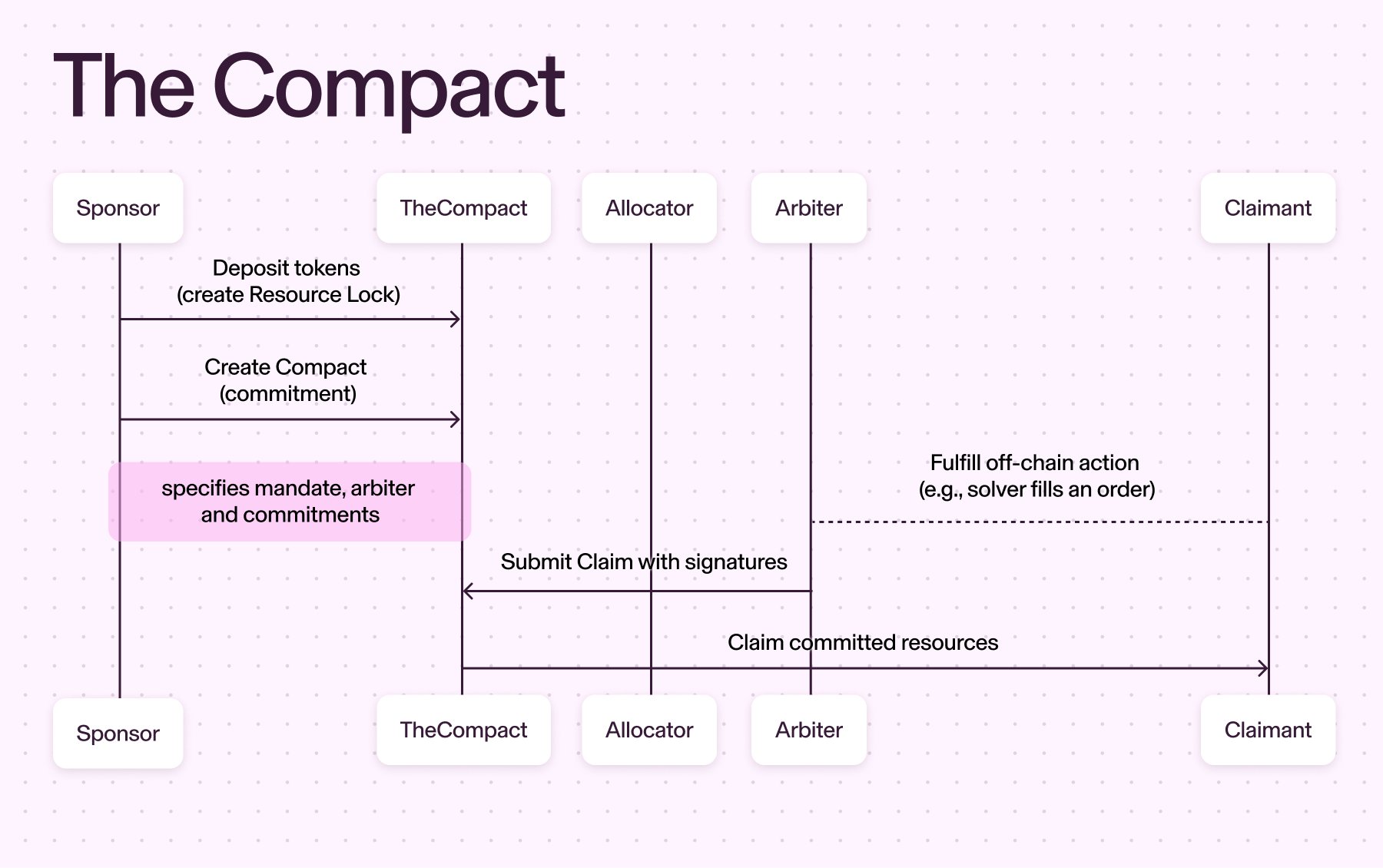
The decentralized trading protocol has announced The Compact, an open-source contract system aiming to make applications and digital assets interoperable.
The Compact is an open-source composable smart contract system that enables seamless crosschain interoperability
Here’s how it works 🦄 pic.twitter.com/QgY1MRL13X
— Uniswap Labs 🦄 (@Uniswap) October 8, 2025
That means users can move apps and assets from across various chains without risky or complicated workarounds.
Generally, The Compact allows users to “commit” tokens for specified actions, like cross-chain operations or swaps, while retaining control.
It is an innovative way of locking assets securely while allowing them to move credibly and freely across different platforms.
The official blog indicated:
The Compact enables secure cross-chain settlement through a system of reusable Resource Locks and programmable commitments. When sponsors deposit assets, they create ERC6909 tokens representing those locked assets, which remain under the sponsors’ control.
Meanwhile, Uniswap’s new release might transform how decentralized applications interact with each other.
Rather than each project creating its escrow solution or bridge, The Compact offers a shared platform that all developers can utilize, adapt, and trust.
The current DeFi landscape comprises hundreds of blockchains, sidechains, and rollups, each boasting its own standards and tools.
These fractures create substantial challenges.
For instance, developers might find themselves rebuilding similar infrastructure.
Also, users have to juggle several wallets, while others deal with trapped tokens after using incompatible systems.
Uniswap Labs seeks to fix that using The Compact.
With this framework, individuals can access a common set of tools when managing value across chains.
That means protocols can offer cross-chain functionalities without surrendering decentralization or security.
DeFi projects have struggled to communicate without a collective framework.
Each protocol has had to create a bridging system or escrow, which leads to user friction, rigid trust models, and fragmented liquidity.
The Compact introduces the missing piece in the puzzle.
With the new system, developers on the Uniswap blockchain can remove the complexity of an asynchronous environment.
Users can enjoy simple and declarative compatibility without bridges or wallets.
The team declared:
With The Compact, developers can finally offer simple, declarative interactions where users never have to navigate the underlying complexity without building new infrastructure that risks ecosystem fragmentation.
Uniswap’s token has struggled in the past few sessions, despite broader market rallies.
UNI is trading at $7.88 after losing nearly 20% of its value the previous month.
The coin has consolidated the previous week, and prevailing sentiments suggest a possible breakout to the upside.

Overcoming the resistance around $8.40 could support UNI recoveries to $12 and $18 amid extended broad-based surges.
The post Uniswap (UNI) introduces “The Compact” to power seamless cross-chain interoperability appeared first on CoinJournal.